
Speech Therapy Inferences: How to Teach Inferencing and Build Reading Comprehension
Have you ever worked with a student who can read the words perfectly… but still struggles to understand what the passage actually means?
It’s a common situation in both the classroom and speech therapy. Students may decode the text accurately, but comprehension breaks down when they are asked to explain what happened, predict what might happen next, or understand why a character acted a certain way.
Often, the missing skill is inferencing.
Teaching speech therapy inferences helps students connect clues, background knowledge, and language skills to understand deeper meaning. When students learn how to make inferences, they begin to move beyond simply reading words and start to truly understand what they read.
Inferencing is also one of the key strands of reading comprehension. In our previous article on evidence-based reading comprehension research, we explored how comprehension develops through four connected skills:
- Background knowledge
- Vocabulary development
- Inference generation
- Comprehension monitoring
When students strengthen their ability to make inferences, their overall reading comprehension skills improve significantly.
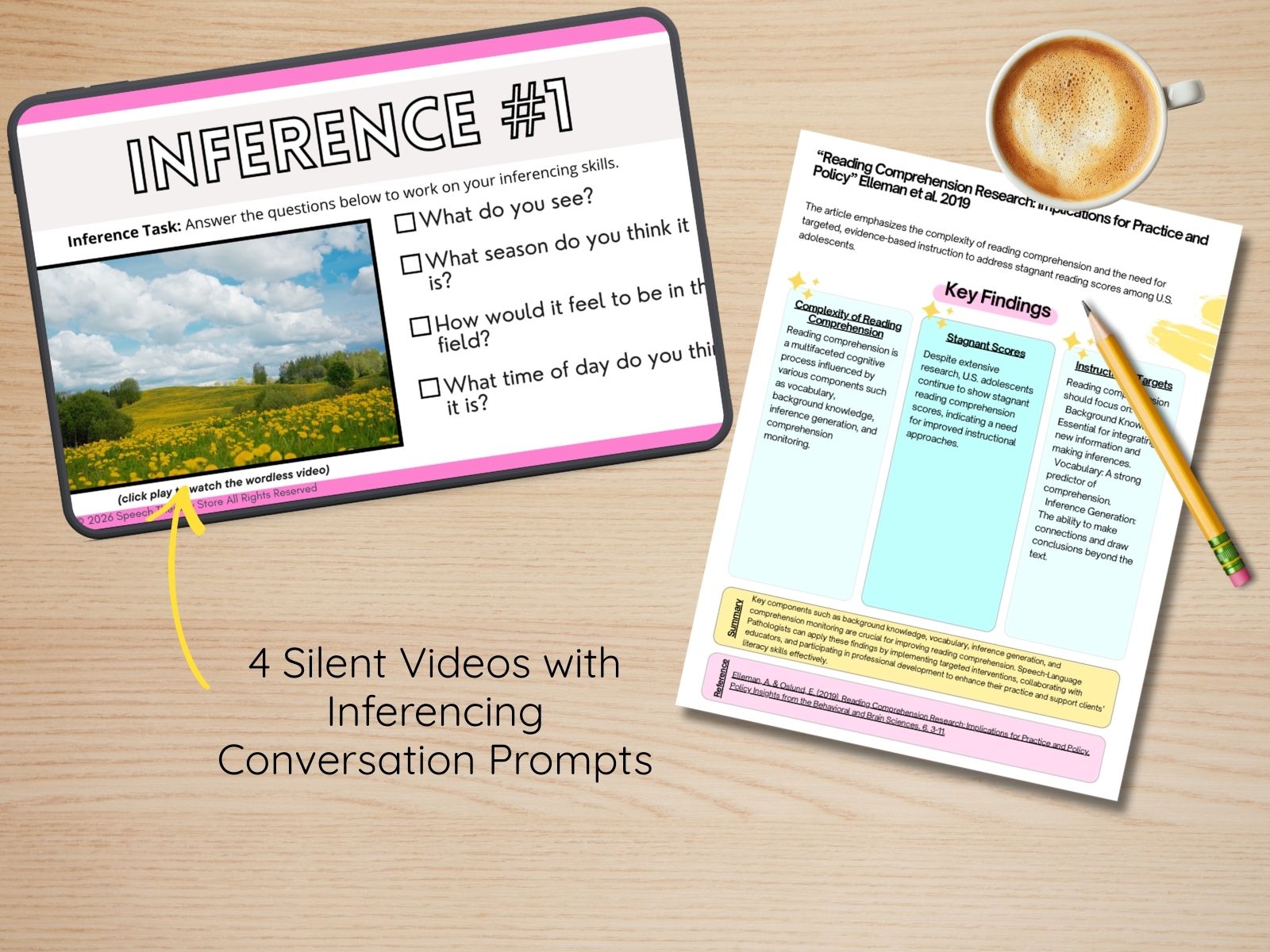
P.S. We created a ready to use Key Findings and How to Apply in Therapy Poster for you that covers the 4 Strands of Reading Comprehension – one of those strands is inferencing. It will greatly benefit you in teaching inferencing and also understanding the newest research in reading comprehension. Grab It Here!
What Are Inferences?
An inference is a conclusion we reach by combining clues with what we already know.
In simple terms:
Clues + Background Knowledge = Inference
Students use inferencing to figure out information that is not directly stated in a story, picture, or situation. Instead of relying only on literal information, they learn to read between the lines.
For example, if a story describes a character grabbing an umbrella and putting on boots before leaving the house, the text may never say that it is raining. However, students can infer that it is raining based on the clues.
This ability to make inferences is essential for reading comprehension because many texts require students to interpret information that is implied rather than explicitly stated.
When students struggle with inferencing reading strategies, they may find it difficult to:
- understand character motivations
- predict outcomes in stories
- connect ideas within a text
- explain why events happen
Teaching making inferences in speech therapy helps students build the reasoning and language skills needed to understand meaning beyond the surface level.
Why Inference Skills Matter for Reading Comprehension
Inferencing plays a critical role in how students understand written and spoken language.
Research shows that reading comprehension is a complex cognitive process influenced by several interacting skills. These include vocabulary knowledge, background knowledge, inference generation, and comprehension monitoring.
Among these skills, inference generation is often the bridge between language understanding and reading comprehension.
When students make inferences, they actively connect:
- information from the text
- their own background knowledge
- context clues within the story or situation
This allows them to build a deeper understanding of what they are reading.
Without strong inference skills, students may understand individual sentences but struggle to grasp the overall meaning of a passage. They may miss subtle clues about characters, misunderstand cause-and-effect relationships, or have difficulty predicting what might happen next.
Strengthening inference skills for reading comprehension helps students become more flexible and thoughtful readers. Instead of focusing only on literal information, they begin to analyze, reason, and interpret meaning more effectively.
FOR YOU! Looking for speech resources for Question Goals? Grab our 179+ WH Questions Freebie! We also have a WH-Questions Flashcards MEGA Bundle in the shop – 75 WH Questions for each of the 15 Fun Themes. Practice these digitally or print and go!

How to Teach Inferences in Speech Therapy
Speech therapy is a natural setting for teaching inference skills because inferencing relies heavily on language comprehension, reasoning, and vocabulary knowledge.
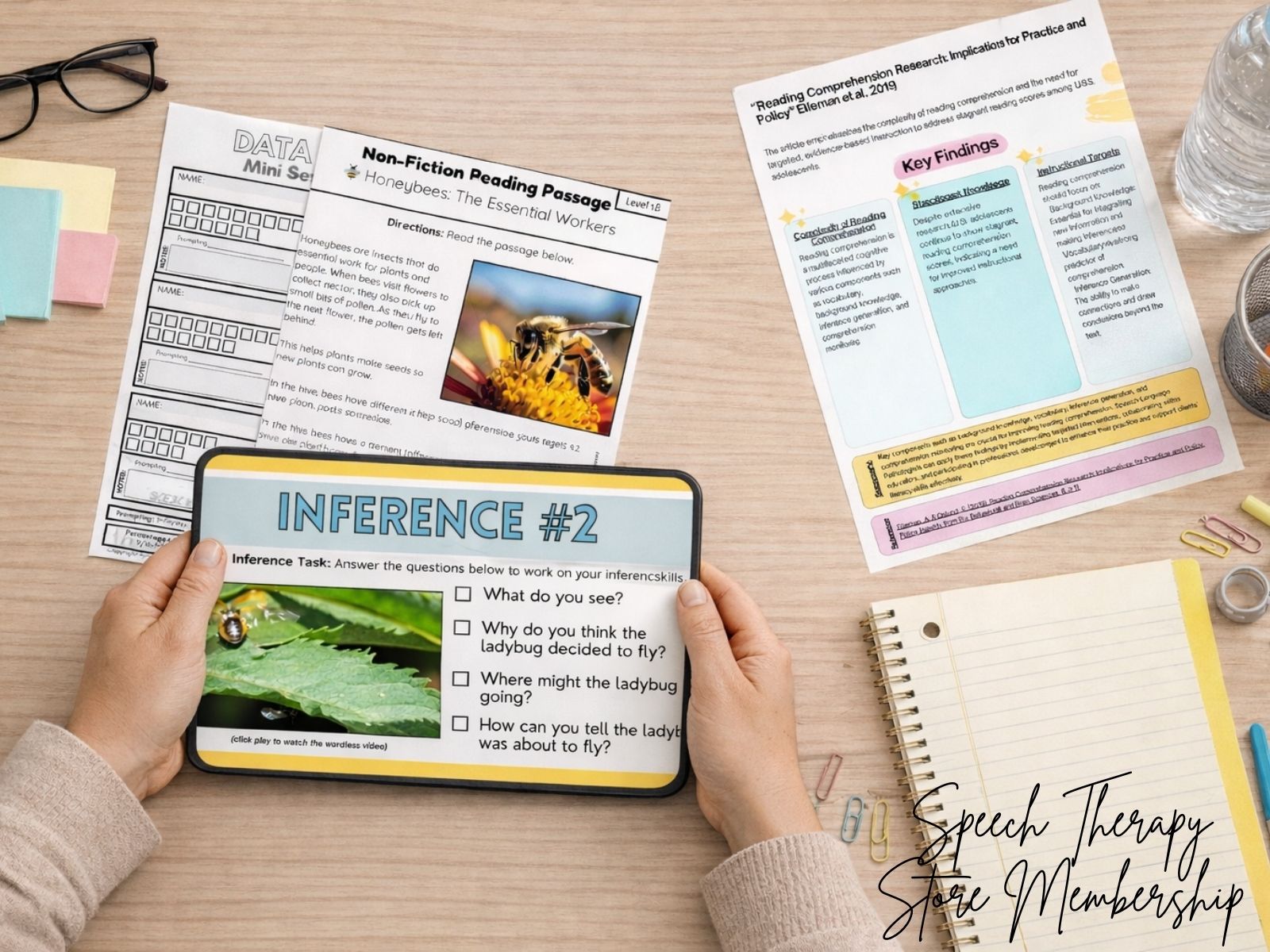
Inside the Speech Therapy Store Membership, inferencing practice is woven throughout monthly themed units. Students explore nonfiction and fictional texts, practice reasoning through discussion prompts, and build vocabulary and comprehension together. Everything is differentiated across three levels so it can easily support a wide range of students.
When we teach speech therapy inferences, we are strengthening multiple language skills at the same time.
Language Comprehension
Students must understand the information they hear or read in order to connect clues and build meaning. Practicing inferencing supports overall language comprehension therapy by encouraging students to process information more deeply.
Vocabulary Development
Vocabulary knowledge plays an important role in inferencing. Students rely on word meanings and context clues to interpret information and understand what might be happening in a story or situation.
Targeting vocabulary alongside inferencing helps students develop stronger speech therapy reading comprehension skills.
BONUS! Here is our master list of 2000+ Tier 2 Words for K-12th grade. It aligns with our Tier 2 Curriculum. And — The Speech Therapy Store Membership is where you want to go for tier vocabulary resources that are embedded in themed articles (plus 575+ other pages of organized language, articulation and social pragmatic resources!)
Reasoning and Problem-Solving
Inferencing requires students to combine pieces of information and draw logical conclusions. These reasoning skills help students explain their thinking and justify their answers.
Social Inference
Inferencing is also essential for understanding social situations. Students use social inference skills to interpret:
- emotions
- intentions
- perspectives
- body language
These skills support both social communication and academic comprehension.
Narrative Comprehension
In stories, students use inferencing to understand:
- character motives
- why events occur
- how problems are solved
This strengthens narrative comprehension, which is closely connected to reading comprehension development.
P.S. Here is some great Evidence-Based Research on Narrative Comprehension!
Strategies for Teaching Inference Skills in Speech Therapy
There are many effective ways to teach making inferences in speech therapy sessions. The key is to model the thinking process and provide students with opportunities to practice combining clues with background knowledge.
Think-Alouds
Think-alouds allow therapists to model how inferencing works. As you read a story or observe a picture together, you can verbalize your thinking process.
For example:
“The character grabbed a coat and umbrella before leaving. That makes me think it might be raining outside.”
Modeling these reasoning steps helps students learn how to use inferencing strategies in a clear and explicit way.
Picture Scenes
Picture scenes provide visual clues that encourage students to make inferences about what is happening.
Students can examine the picture and discuss:
- what might have happened before
- what might happen next
- why characters are behaving a certain way
Picture-based inference activities for speech therapy are especially helpful for students who benefit from visual supports.
Silent Videos
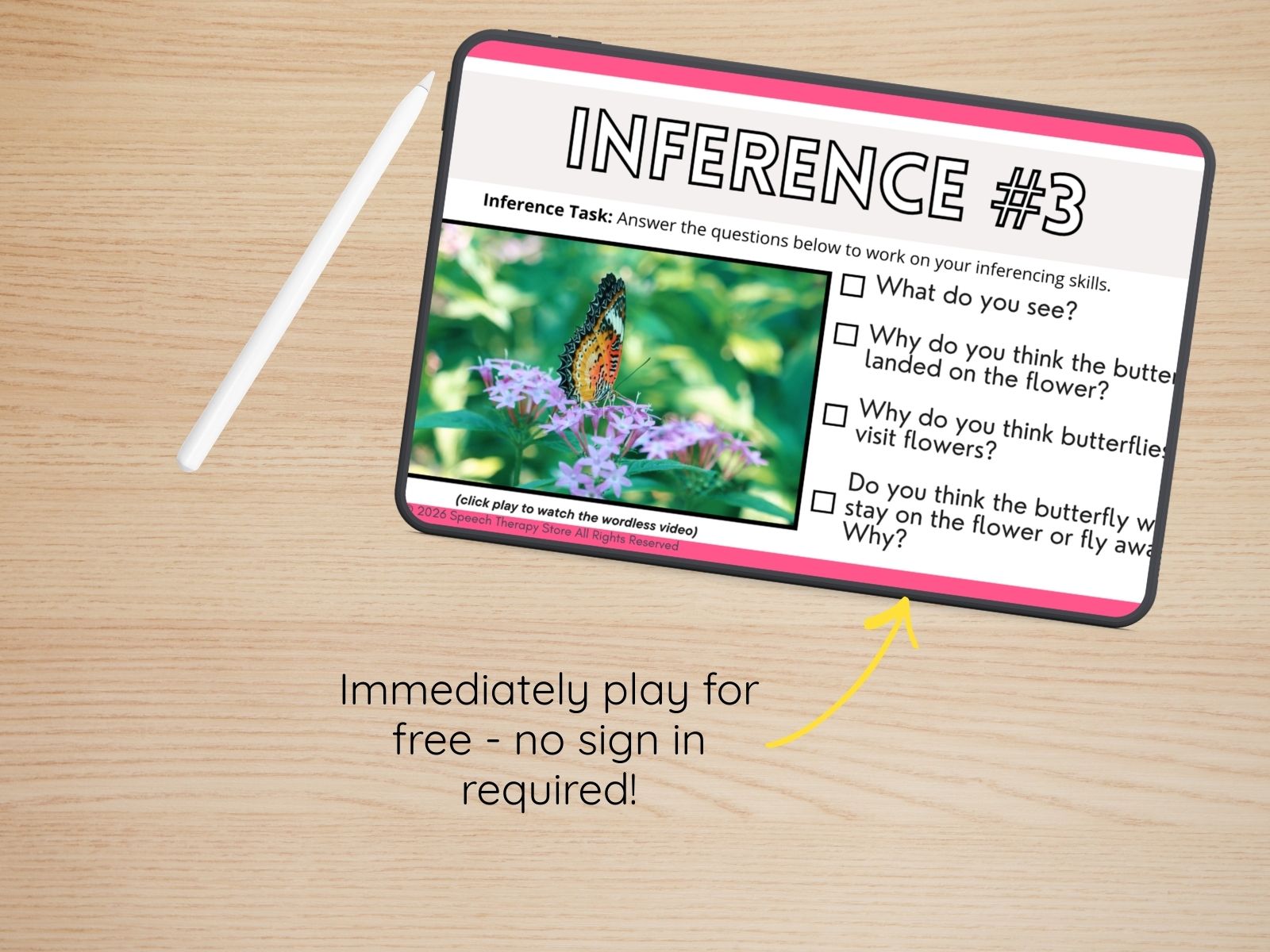
Short silent videos are a powerful way to practice inferencing. Because there is no dialogue, students must rely on visual clues to determine what is happening.
Students can infer:
- actions
- emotions
- intentions
- future outcomes
Silent videos create engaging inference activities for speech therapy sessions that feel more like solving a puzzle than completing a worksheet.
Download the Free Silent Video Canva Activity Below!
Story Discussions
Stories provide many opportunities for inferencing. During story discussions, students can practice answering questions such as:
- Why did the character do that?
- How might the character be feeling?
- What do you think will happen next?
These types of inference questions for reading comprehension help students connect ideas across a story.
Check These Out! We have some AMAZING Book Companions that encourage comprehension, questions, retelling, vocabulary and more language + articulation goals! Grab Our Up in the Garden, Down in the Dirt Free Book Companion, or try the When Spring Comes Book Companion this season!
How to Make Inference Activities Fun and Engaging
Students are often more motivated when inference practice feels like problem-solving rather than traditional question-and-answer tasks.
There are many ways to create fun inference activities that keep students engaged while building important language skills.
Some engaging ideas include:
- guessing games based on clues
- mystery picture activities
- prediction games during stories
- real-world problem-solving scenarios
- silent video discussions
- small group reasoning activities
These types of inference games for speech therapy encourage students to actively analyze information and explain their thinking.
Using interactive activities helps students practice inferencing in a way that feels natural and engaging rather than repetitive.
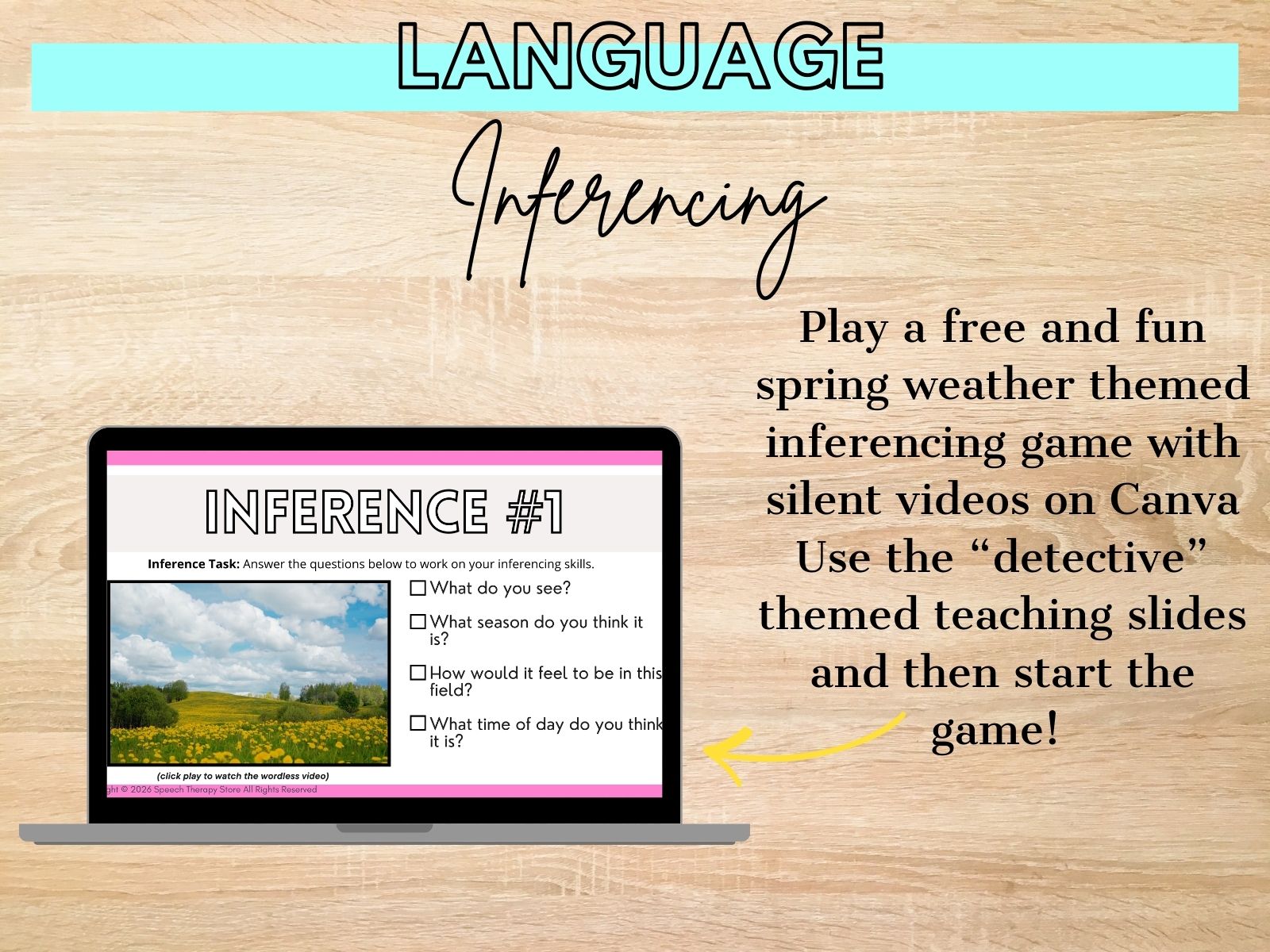
Grab the FREE Inferencing Canva Below! It starts with an engaging “inferencing detective” teaching slide and then works through 4 silent videos with inferencing prompts! Each silent video has an engaging spring weather themed video!
Free Speech Therapy Inference Activity
If you’re looking for an easy way to practice inferencing in your therapy sessions, I created a free speech therapy inference activity designed to help students strengthen their reasoning and comprehension skills.
This activity uses short silent video clips that encourage students to:
- analyze visual clues
- connect background knowledge
- make predictions
- explain their reasoning
These types of making inferences speech therapy activities help students practice inferencing in a meaningful and engaging way.
You can grab the free activity here and start using it in your speech therapy sessions.

Why Inferencing Is One of the Most Important Skills for Comprehension.. and How The Speech Therapy Store Membership Naturally Ties It All In
Inferencing is one of the most powerful tools students can develop for understanding language and text.
When students learn how to make inferences, they become better able to:
- understand deeper meaning in stories
- connect ideas across sentences and passages
- interpret characters and events
- think critically about what they read
Strengthening speech therapy inferencing skills helps students become more confident and capable readers.
By incorporating inference activities for speech therapy, we can help students build the reasoning, language, and comprehension skills they need to succeed both academically and socially.
If you enjoy using inference activities like this in your sessions, you’ll find even more built into the Speech Therapy Store Membership.
Each month includes 575+ fresh pages of themed materials designed to strengthen reading comprehension, vocabulary, and inferencing skills together. Members receive nonfiction articles, fictional stories, vocabulary activities, articulation practice, extension activities, and built-in data trackers — all differentiated across three levels so you can support a wide range of students.