
You ask a student what they did over the weekend, and you get every detail… in no particular order. The trampoline, the cousin, the pizza, something about a dog, and then back to the trampoline. They have SO much language, but the story just doesn’t hang together. That’s exactly where narrative intervention in speech therapy comes in.
If that sounds like half your caseload, you’re in good company. Narrative skills sit right in the middle of everything we target: vocabulary, grammar, sequencing, comprehension, and social communication. And the research on narrative intervention is some of the most encouraging we have.
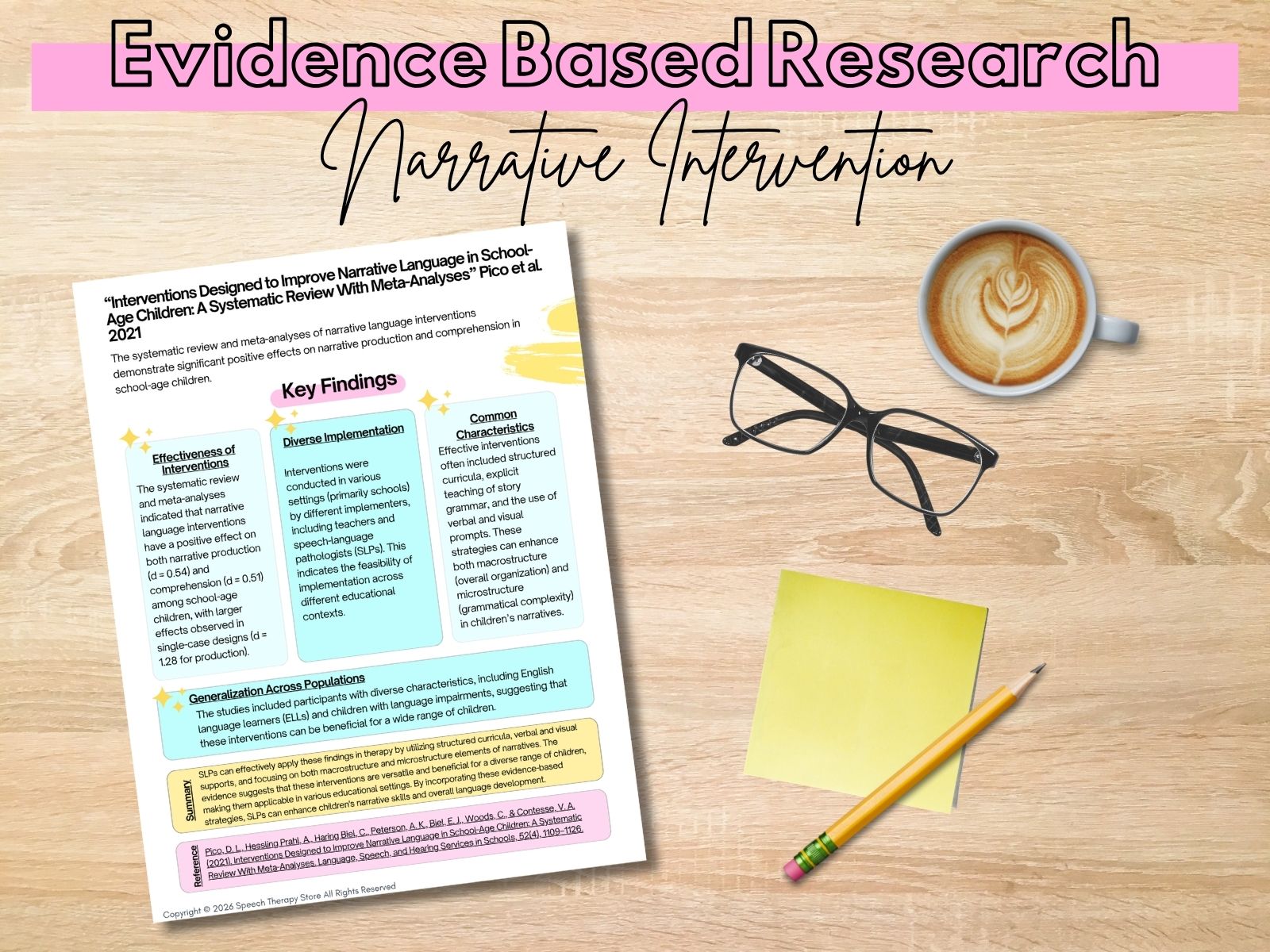
In this post, I’m breaking down a large systematic review and meta-analysis on narrative intervention (Pico et al., 2021), what it means for your therapy room, and how to put it into practice without spending your whole Sunday planning. Plus, you can grab a free Narrative Intervention Key Findings Poster that sums it all up on one page.
A Quick Note on Narrative Resources
If you’re building out your narrative toolbox, here are a few places to start:
- 👉 Narrative Intervention Activity Pack: 134 pages of story grammar, sequencing, and story generation practice at two levels, with IEP goals and a tracking sheet built in.
- 📚 Want the foundational principles first? Check out our earlier post on narrative intervention principles to practice (Spencer & Petersen, 2020).
- 🎯 Writing goals this month? Our narrative goals for speech therapy IEP bank covers sequencing, story grammar, syntax, and personal narratives.
What Is Narrative Intervention in Speech Therapy?
Narrative intervention is a language approach that uses stories (retelling them, telling personal stories, and creating new ones) to build oral language. Instead of practicing skills in isolation, students work on vocabulary, sentence structure, sequencing, and comprehension all inside one meaningful context: a story.
Most narrative intervention is built around story grammar, the predictable parts that make up a story: character, setting, problem, feelings, actions, consequence, and ending. When students learn that framework, they finally have a map for organizing their ideas, whether they’re retelling a book, explaining what happened at recess, or writing a paragraph in class.
What the Research Says About Narrative Intervention in Speech Therapy
The study we’re looking at is “Interventions Designed to Improve Narrative Language in School-Age Children: A Systematic Review With Meta-Analyses” by Pico and colleagues, published in Language, Speech, and Hearing Services in Schools in 2021. Instead of one small study, the authors reviewed 40 studies of narrative intervention with preschool and elementary school-age children in the United States, then pooled results from 26 of them in meta-analyses. That makes it a strong, encouraging place to start when anchoring our clinical decisions. The authors also note that the studies had some risk-of-bias concerns, so think of the effect sizes as a promising signal rather than a guarantee.
Here’s what they found.
1. Narrative Intervention Improves Storytelling AND Comprehension
Narrative language interventions had a positive, moderate effect on both narrative production (how well students tell stories) and narrative comprehension (how well they understand them). Effects on storytelling were even larger in single-case design studies, which typically involve small numbers of students and highly individualized instruction.
Why this matters: When you target story structure, you aren’t only working on expressive language. You’re building the same mental framework students use to understand what they hear and read. That’s a big deal for students with reading comprehension goals, too. (If inferencing is on your radar, our post on how to teach inferences in speech therapy pairs nicely with this one.)
2. It Works in Real Schools, With Real Providers
The interventions in this review took place mostly in schools and were delivered by a mix of implementers, including SLPs and classroom teachers.
Why this matters: Narrative intervention isn’t a “perfect lab conditions only” approach. It’s realistic for pull-out groups, push-in lessons, and collaboration with teachers. Story grammar is already part of the ELA curriculum, so it’s one of the easiest places to align your goals with what’s happening in the classroom.
3. The Most Effective Interventions Shared a Few Key Ingredients
Across studies, effective narrative interventions often included:
- Structured lessons or curricula with a clear sequence
- Explicit teaching of story grammar
- Visual and verbal prompts like story maps, icons, and guiding questions
- Opportunities for students to produce narrative language themselves, not just listen to stories
These strategies strengthened both macrostructure (the overall organization of the story, like including a problem and a resolution) and microstructure (the language inside the story, like complex sentences, conjunctions, and precise vocabulary).
Why this matters: A “good” narrative needs both. A student might hit every story grammar part but use only short, simple sentences. Another might use beautiful vocabulary in a story with no problem at all. Targeting both levels gives you a fuller picture and more natural goals.
4. It Helps a Wide Range of Students
The studies included students with diverse profiles, including English language learners and children with language impairments.
Why this matters: This is one of those approaches you can use across your caseload. With the right level of support, the same story can work for a student learning basic story parts and a student working on complex sentences.
Free Narrative Intervention Key Findings Poster
To make this research easy to reference, we created a free Narrative Intervention Key Findings Poster that summarizes the Pico et al. (2021) findings on one page.
You can use it to:
- 🗂️ Guide your therapy planning
- 🎯 Support narrative IEP goal writing
- 🧠 Reference the research during team meetings and teacher collaboration
- 📌 Keep evidence-based strategies front and center
How to Apply Narrative Intervention in Speech Therapy With the Membership
Knowing what the research says is step one. Actually building structured, visual, story-based lessons every week for a full caseload is where it gets hard. That’s exactly why we built narrative practice right into every monthly unit of the Speech Therapy Store Membership.
Here’s how each research finding shows up inside the membership.
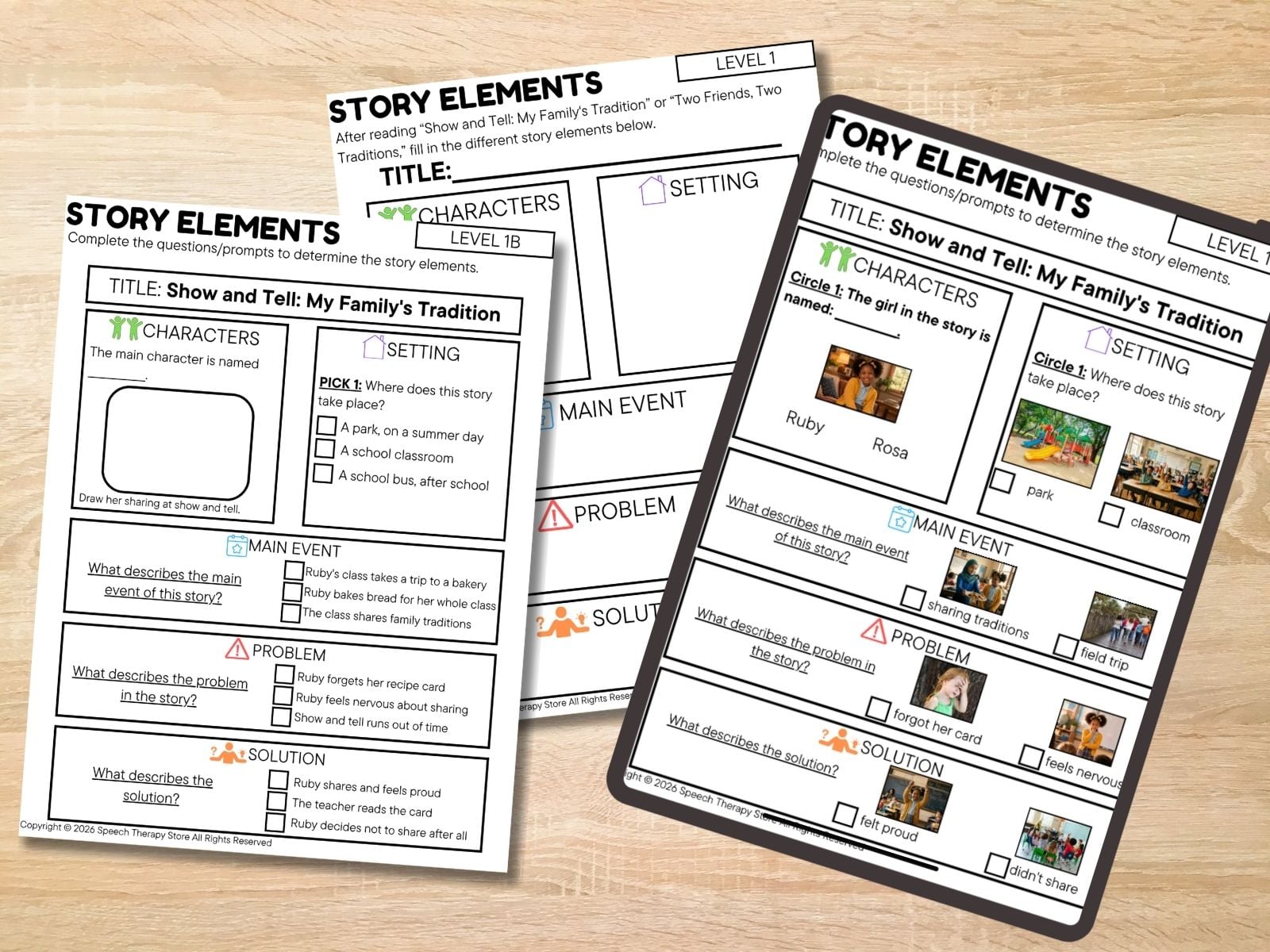
Explicit Story Grammar Instruction: Story Elements & Sequencing Retell
What the research says: Effective interventions teach story grammar explicitly.
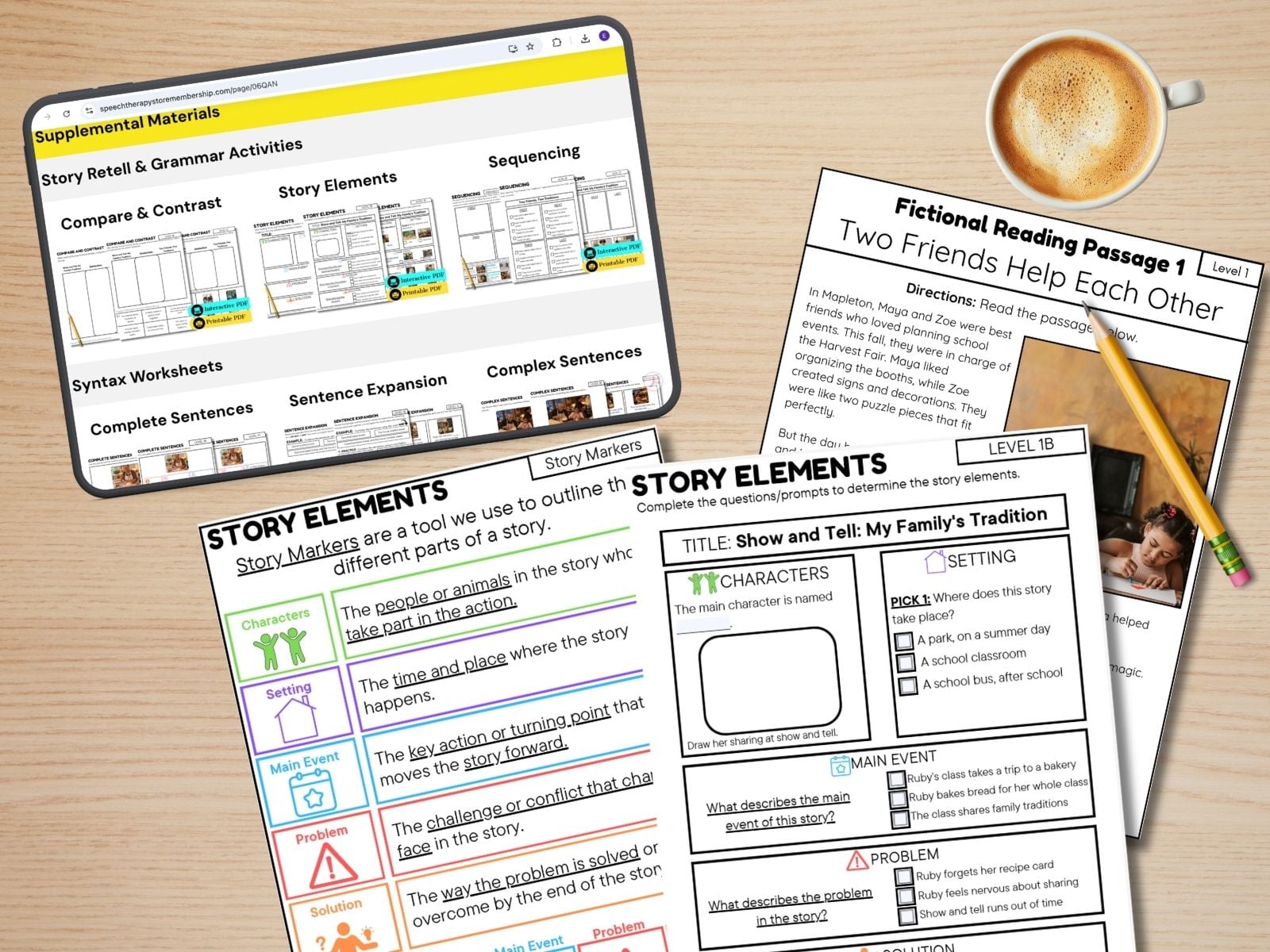
Inside the membership: Every monthly unit includes a Story Elements & Sequencing Retell activity. Students identify the character, setting, problem, and solution, then put the events in order and retell the story using a graphic organizer.
Repeated Practice With Similar Structures: Two Fictional Stories Every Month
What the research says: Effective interventions are built on structured lessons with a clear, predictable sequence.
Inside the membership: Each unit includes two original fictional stories built around the monthly theme. Using two stories with a similar structure gives students multiple exposures to the same story grammar framework, which supports generalization.
Visual and Verbal Supports: Differentiated at 3 Levels
What the research says: Visual and verbal prompts strengthen both story organization and the language inside it.
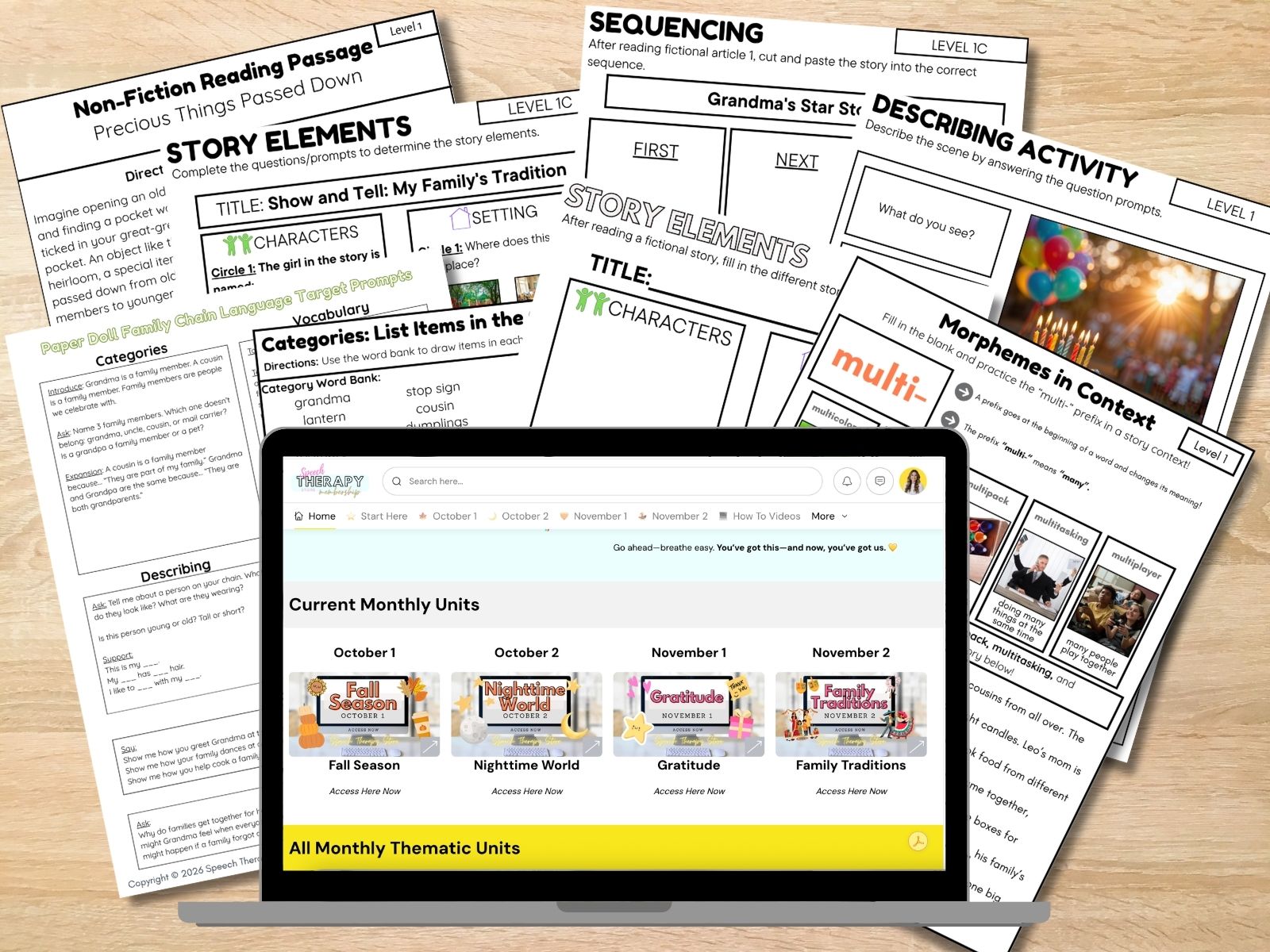
Inside the membership: Narrative activities come in three differentiated levels, with picture supports and graphic organizers built in. You can run one story with a mixed group and still meet each student where they are, which is exactly the “wide range of students” finding in action.
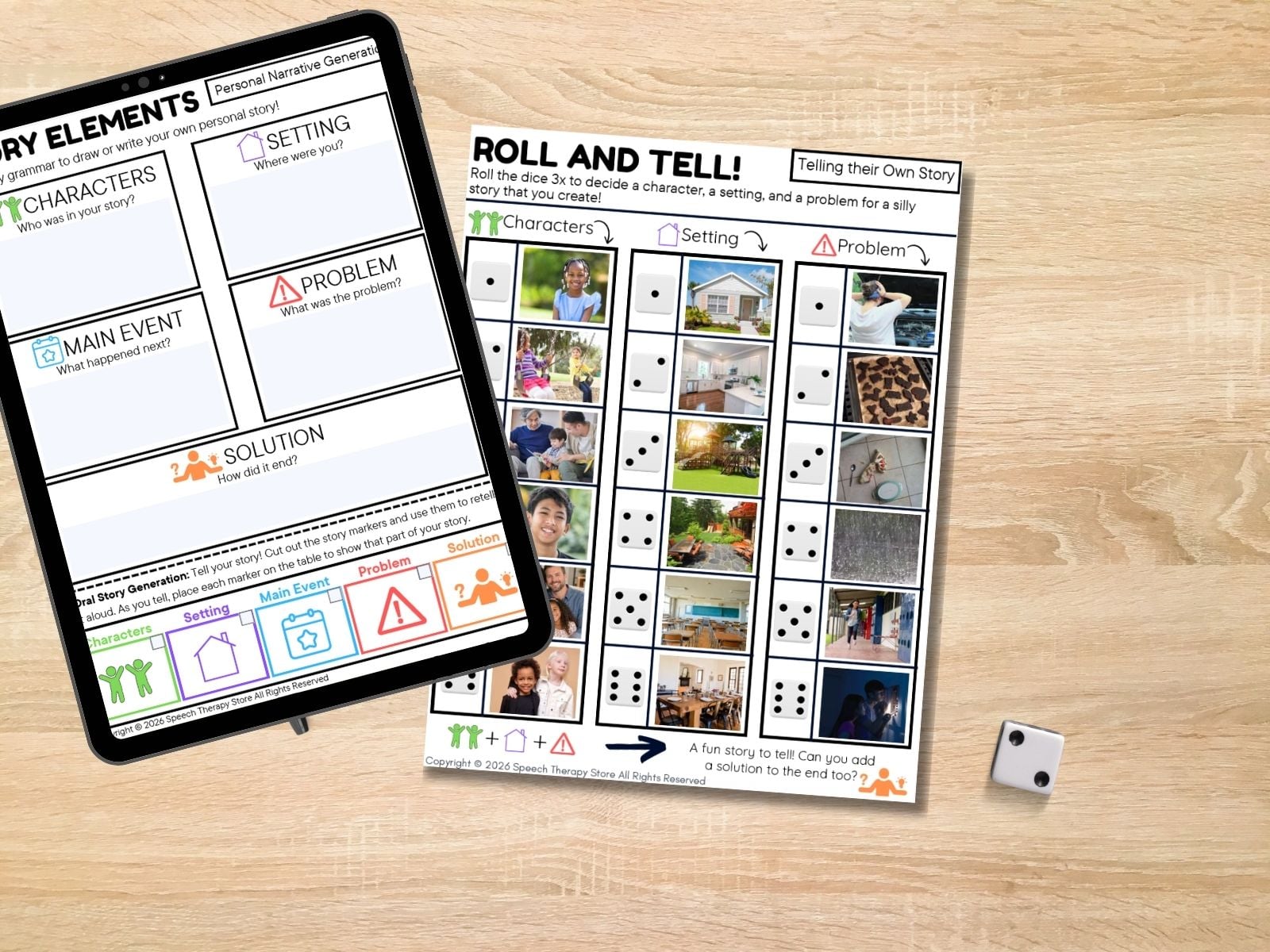
Story Generation in Narrative Intervention: Tell Your Own Story
What the research says: Strong narrative intervention targets both macrostructure and microstructure, and students need chances to produce their own narratives.
Inside the membership: Our Tell Your Own Story prompts move students from retelling to creating. It’s the perfect place to push for longer, more complex sentences, transition words, and Tier 2 vocabulary while students build their own stories and personal narratives.
Connecting Narratives to Comprehension: Story Questions and Inference Practice
What the research says: Narrative intervention improves narrative comprehension, not just storytelling.
Inside the membership: Each fictional story comes with comprehension questions and inference worksheets, so the same story you used for retell becomes your comprehension lesson too. One story, several goals, zero extra prep.
Tracking Progress on Narrative Goals
Inside the membership: Every resource comes with interactive data tracking pages for each of the three differentiated levels, so you can take data right on the page you are already using. Pair that data with the goals from our narrative IEP goal bank, and progress reports get a whole lot easier.

Inside the Membership, You’ll Find:
- ✨ 575+ pages of themed, no or low-prep materials every month
- ✨ Narrative retells, story grammar, and Tell Your Own Story activities in every unit
- ✨ Nonfiction articles, Tier 2 vocabulary, and background knowledge activities
- ✨ Articulation, language, and social skills, all built around one theme
- ✨ Three differentiated levels for your whole caseload
- ✨ Digitally interactive and printable, and you keep what you download
Curious how it all fits together? Take a peek at how we differentiate inside the membership or see how one session can target narrative, vocabulary, comprehension, and morphology together.
Frequently Asked Questions About Narrative Intervention in Speech Therapy
What is narrative intervention in speech therapy?
Narrative intervention uses stories, including story retell, personal narratives, and story generation, to teach oral language skills. It typically focuses on story grammar along with the vocabulary and sentence structure students use to tell a story.
Is narrative intervention evidence-based?
Yes. A 2021 systematic review and meta-analysis by Pico and colleagues found that narrative language interventions had positive effects on both narrative production and narrative comprehension in preschool and elementary school-age children.
What is story grammar in speech therapy?
Story grammar is the set of predictable parts that make up a story, such as character, setting, problem, feelings, actions, consequence, and ending. Teaching story grammar explicitly gives students a framework for understanding and telling stories.
What is the difference between macrostructure and microstructure?
Macrostructure is the overall organization of a story, like whether it includes a problem and a resolution. Microstructure is the language inside the story, such as sentence complexity, conjunctions, and vocabulary. Effective narrative intervention targets both.
Does narrative intervention help reading comprehension?
Narrative intervention improved narrative comprehension in the Pico et al. (2021) review, and understanding story structure supports how students make sense of stories they hear and read. It pairs well with targeted inference instruction and vocabulary work.
More Narrative and Evidence-Based Resources
- 10 Simple Narrative Goals for Speech Therapy (IEP Bank)
- Narrative Intervention Research: Principles to Practice
- How to Teach Inferences in Speech Therapy (Free Game!)
- 31 Best Wordless Videos for Speech Therapy
- All of our Evidence-Based Research Summaries
Reference: Pico, D. L., Hessling Prahl, A., Haring Biel, C., Peterson, A. K., Biel, E. J., Woods, C., & Contesse, V. A. (2021). Interventions designed to improve narrative language in school-age children: A systematic review with meta-analyses. Language, Speech, and Hearing Services in Schools, 52(4), 1109–1126. https://doi.org/10.1044/2021_LSHSS-20-00160