
You know that moment in a session when a student stumbles over a word like “undelivered,” and you can see them trying to sound it out letter by letter instead of breaking it into pieces they already know? That’s usually not a decoding problem. That’s a morphology problem — and it’s one of the most overlooked pieces of language intervention.
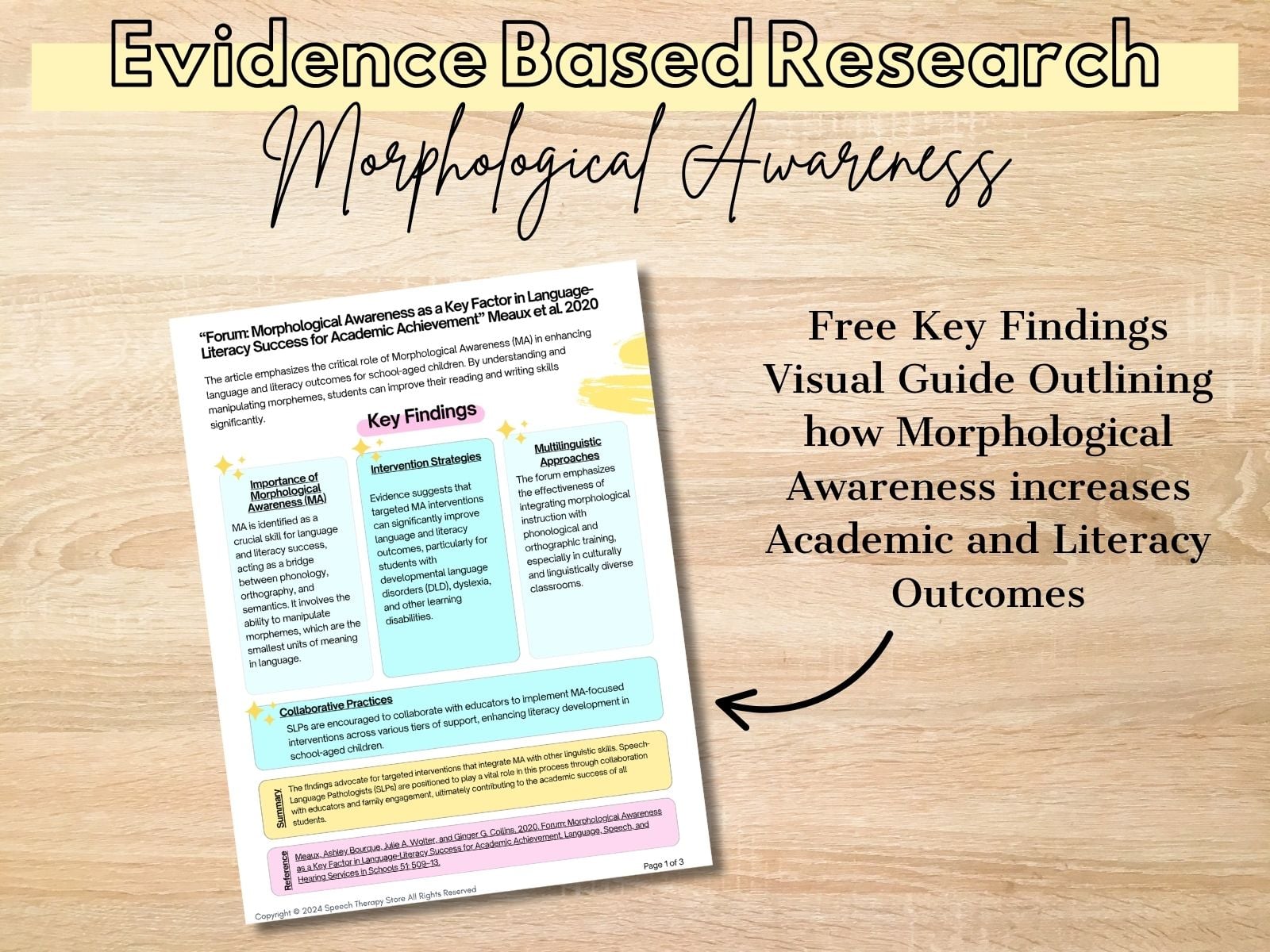
Morphological awareness — the ability to recognize and use the smallest meaningful parts of words, like prefixes, suffixes, and root words — turns out to be a much bigger deal than “know your affixes” worksheets make it seem. So today we’re breaking down what the research actually says about morphological awareness, why it matters for the kids on your caseload, and handing you a free Key Findings poster so you don’t have to read the study yourself.
Looking for More Morphology Resources?
- Free morpheme-in-context worksheets — practice prefixes and suffixes in real sentences.
Click HERE to jump to The Best Speech Activity to Teach Morpheme Awareness - Semantic Networks research breakdown — how word connections drive vocabulary growth.
Click HERE to jump to Semantic Networks in Speech Therapy - Tier 2 Vocabulary Instruction — the evidence-based guide behind our vocab curriculum.
Click HERE to jump to Tier 2 Vocabulary Instruction
🔬 What the Research Says About Morphological Awareness
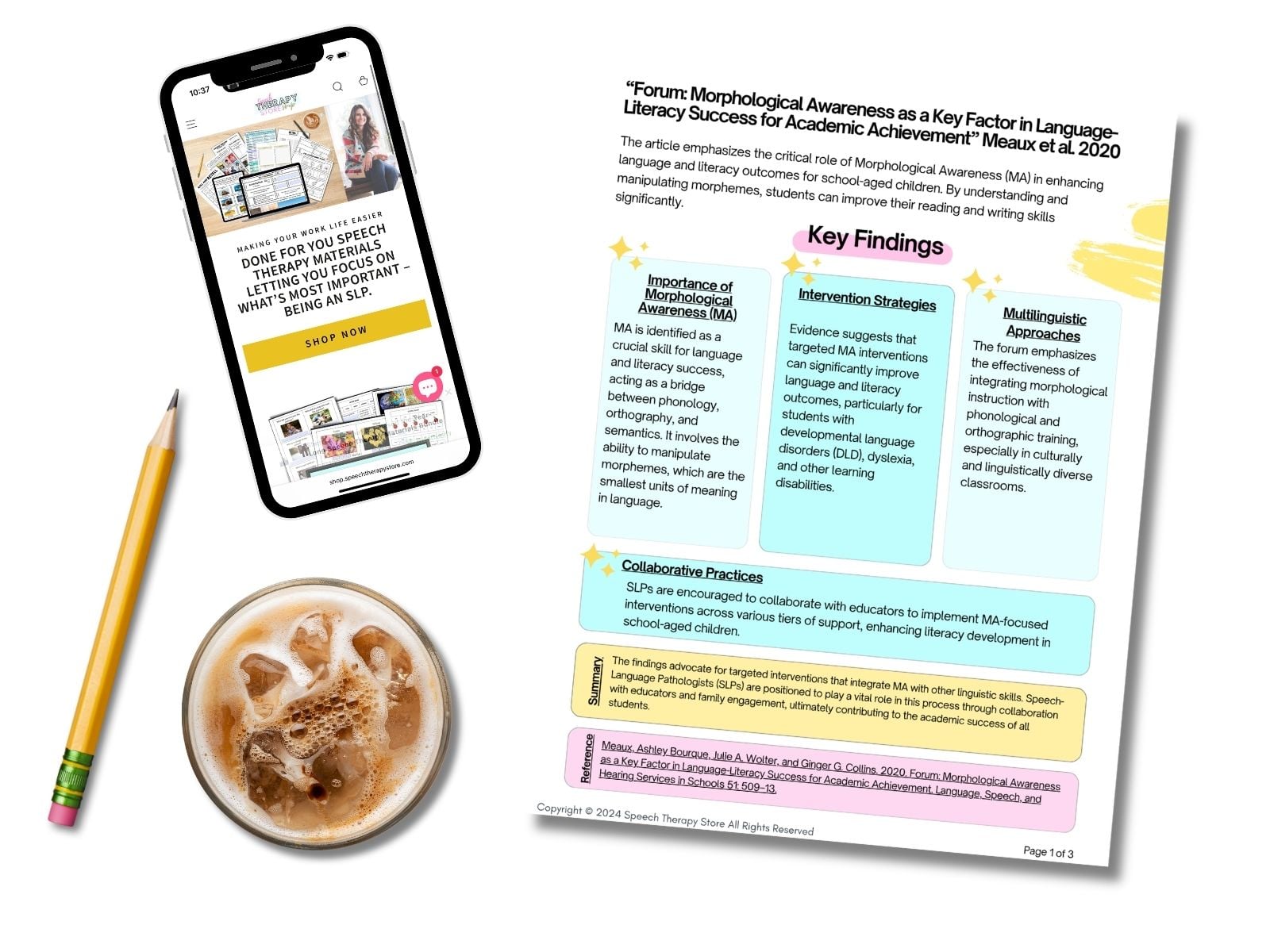
This one comes from Meaux, Wolter, and Collins (2020), published in Language, Speech, and Hearing Services in Schools — a forum piece pulling together what we know about morphological awareness (MA) and why it matters for language and literacy success.
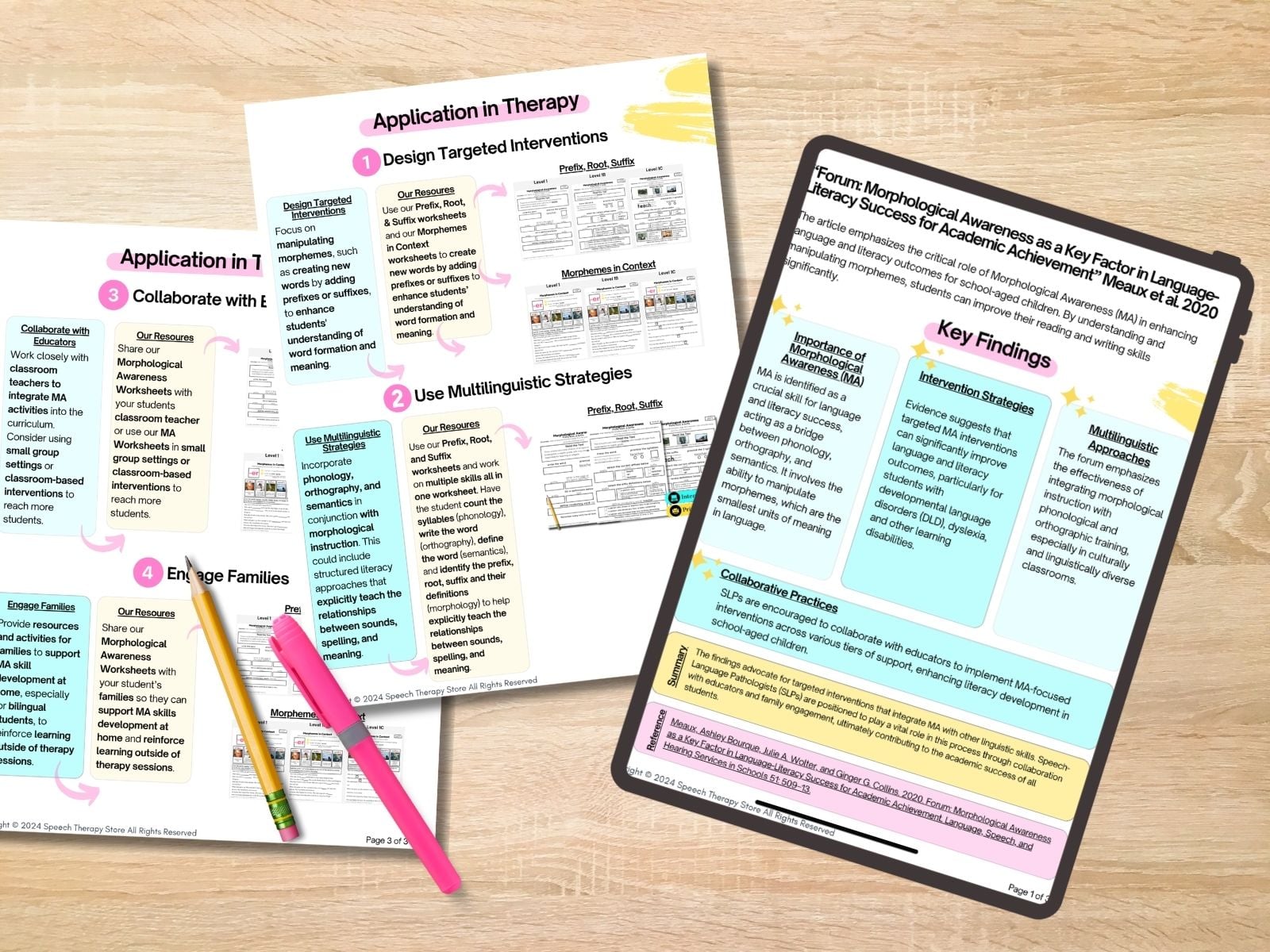
Here’s what stood out:
- MA is a bridge, not a standalone skill. It connects phonology, orthography, and semantics — meaning when a student struggles with morphology, it often shows up as a tangle of spelling, reading, and vocabulary issues that look unrelated but aren’t.
- There are real tools for measuring it. The study points to assessments like the Dynamic Measure of Morphological Awareness (DMMA), which can flag students at risk for literacy failure well before it becomes a bigger problem.
- Targeted intervention works. Students with DLD, dyslexia, and other learning differences showed meaningful gains in language and literacy outcomes when MA was directly and explicitly taught — not just exposed to incidentally.
- The multilinguistic approach wins. Morphology instruction is most effective when it’s paired with phonological and orthographic teaching, especially for culturally and linguistically diverse classrooms.
- This isn’t a solo mission. The researchers are direct about it — SLPs collaborating with classroom teachers across MTSS tiers is what makes MA instruction stick at a school-wide level.
Here’s why this matters in practice: a lot of us were trained to treat vocabulary, spelling, and reading comprehension as separate goal areas. This research makes the case that morphology is the thread running through all three — so when you teach a student that “un-” means “not,” you’re not just building a vocabulary word. You’re giving them a tool they can reuse across reading, writing, and spelling for the rest of their academic life. That’s a pretty good return on one therapy target.
🧩 How the Membership Brings This to Life
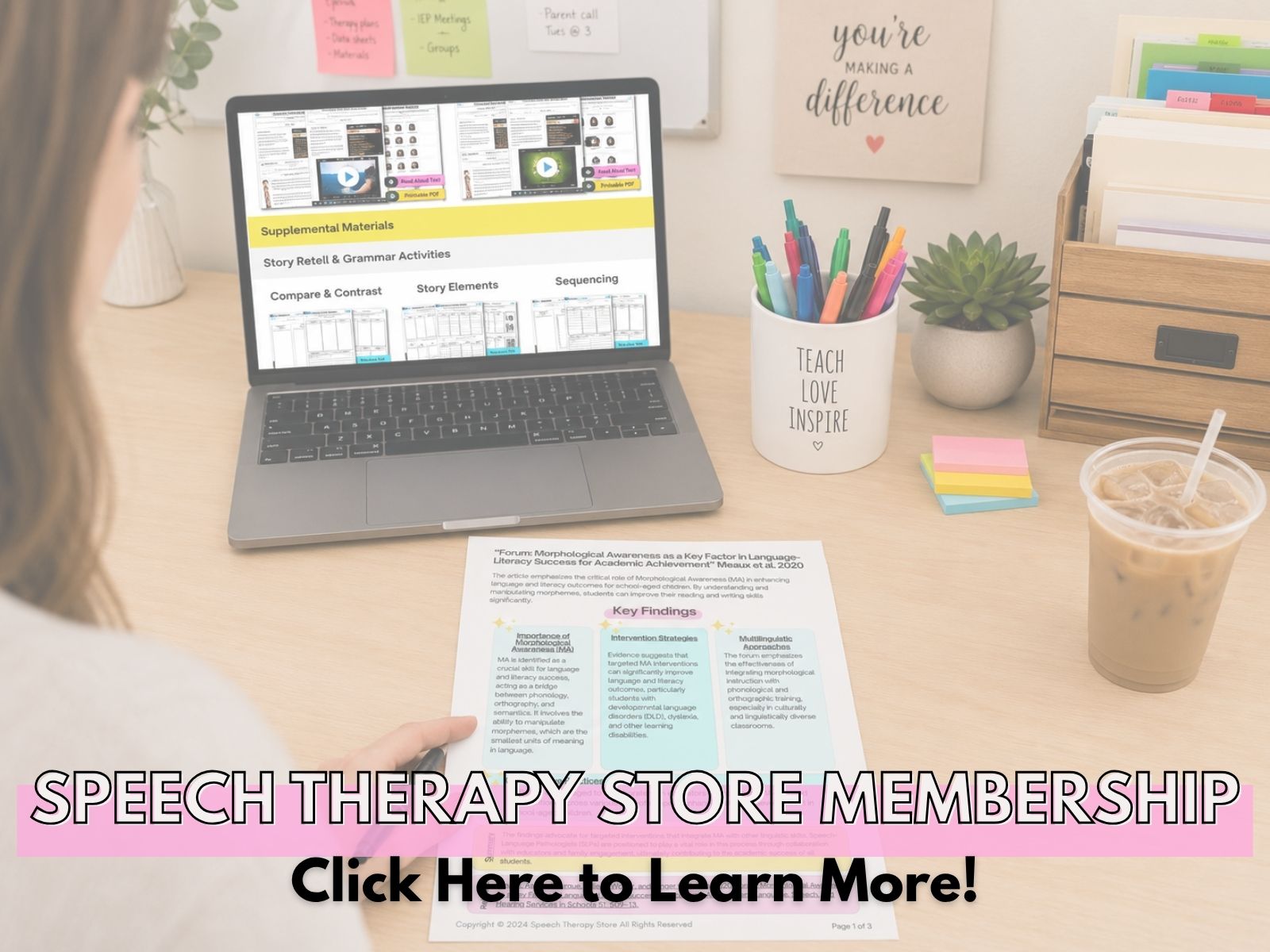
We didn’t just read this study and nod along — we built our membership resources around it.
Differentiated Levels for Every Student
Every morphology activity inside the membership comes in three levels — Level 1, 1B, and 1C — so the same target word and passage can flex from independent practice to heavily scaffolded support with an affix word bank and picture cues. That’s the multilinguistic, tiered approach the research points to, built right in.
Themed Vocabulary, Not Random Word Lists
Instead of drilling prefixes and suffixes in a vacuum, our morphology sets use words students would naturally come across within each month’s theme. Because the vocabulary connects to what they’re already reading, talking about, and practicing in session, students see word parts in meaningful context and have a real reason to use them.
Data Tracking Built In
Every resource includes a data tracking sheet, so you’re not just teaching morphology — you’re documenting progress toward those goals without building your own tracking form from scratch.
A New Themed Bundle Every Month
Membership resources rotate through a new theme monthly — 575+ pages covering articulation, language, and social pragmatic skills — so morphology shows up alongside vocabulary, context clues, and comprehension work all year, not just as a one-off unit.
Learn more about the Speech Therapy Store Membership here!
🎁 Grab Your Free Morphological Awareness Key Findings Poster
Here’s what’s inside this free resource:
- A plain-language breakdown of the Meaux, Wolter, and Collins (2020) study — no journal-speak
- The key findings listed above, formatted as a quick-reference poster
- An “Application in Therapy” page translating each finding into something you can actually do in session
- Full citation and reference page, so you’ve got it on hand for IEP meetings or team discussions
How to use it: Print it and keep it in your therapy binder as a quick refresher before planning morphology goals, or share the Application in Therapy page with a classroom teacher who wants to reinforce the same skills during core instruction.
This freebie was designed with the research findings above in mind — not just a cute poster, but something you can actually reference when you’re building goals or explaining to a teacher why “just memorize the vocab list” isn’t the most effective approach.
🛍️ More Language Resources You’ll Love
📚 Regular & Irregular Past Tense Verbs Bundle
Past tense marking is morphology in action — regular “-ed” endings and irregular forms are exactly the kind of grammatical morpheme the research flags as a common error pattern for students with DLD. This bundle gives you targeted practice for both patterns side by side.
👉 Grab the Regular Past Tense Verbs Bundle here, or pair it with the Irregular Past Tense Verbs Bundle.
❓ WH Questions Mega Bundle
WH-questions are another place kids apply the same “break the language apart to find the meaning” skill morphology targets, just at the sentence level instead of the word level. This 1,125-question bundle covers 15 year-round themes, so you’ve always got a fresh, engaging set ready for goal practice.
Bringing It All Together
Morphological awareness isn’t an “extra” language skill to squeeze in when you have time — it’s a foundational piece connecting vocabulary, spelling, and reading comprehension. The research is clear that explicit, structured instruction in prefixes, suffixes, and root words pays off well beyond a single goal area.
You don’t have to read the full study or build your own materials from scratch to put this into practice — that’s exactly what this Key Findings poster and the membership resources above are here for.
Grab the freebie, keep it on hand for your next goal-writing session, and know that you’re already doing the kind of intentional, research-backed therapy your students need. You’ve got this.
As a former school-based SLP, I’ve lived the chaos of overflowing caseloads, last-minute IEPs, and too many sessions to prep for. That’s why I created Speech Therapy Store: to give you no-prep, interactive, and thoughtfully designed materials that save you time and reduce stress.
You’ve got enough on your plate — I’m here to help, and I’m cheering you on every step of the way.
– Melissa 💛
Want the Best of the Best from Speech Therapy Store?
- 21 Best Reinforcement Games for Speech Therapy / Teletherapy
- Best IEP Resources
- 71+ Free Social Problem-Solving Scenarios
- 430+ Free Multisyllabic Words List Activity Bundle
- 432+ Free Measurable IEP Goals and Objectives Bank
- 279+ Free Speech Therapy Digital Materials
- 179+ Free Speech Therapy Wh-Questions Printable