
A lot of students can label a word — but ask them to describe it, and things fall apart fast. That’s the exact gap describing activities are designed to close.
They know it’s a “pencil.” They can point to one. But ask them what it’s used for, what it looks like, or how it’s different from a crayon, and you’ll often get a blank stare or a one-word guess.
That gap — between knowing a word and really knowing a word — is exactly what research on describing activities and vocabulary instruction points to. And it’s a gap that’s easy to miss, because on the surface, it looks like vocabulary is “fine.”
In this post, we’re breaking down what the research says about describing activities and how they help build vocabulary, including:
- what describing activities actually are (and why they’re different from flashcard-style vocabulary drills)
- what happens when kids only get surface-level word knowledge
- evidence-aligned strategies for using describing activities in speech therapy
- what this looks like inside real therapy sessions
A QUICK NOTE ON THE RESEARCH
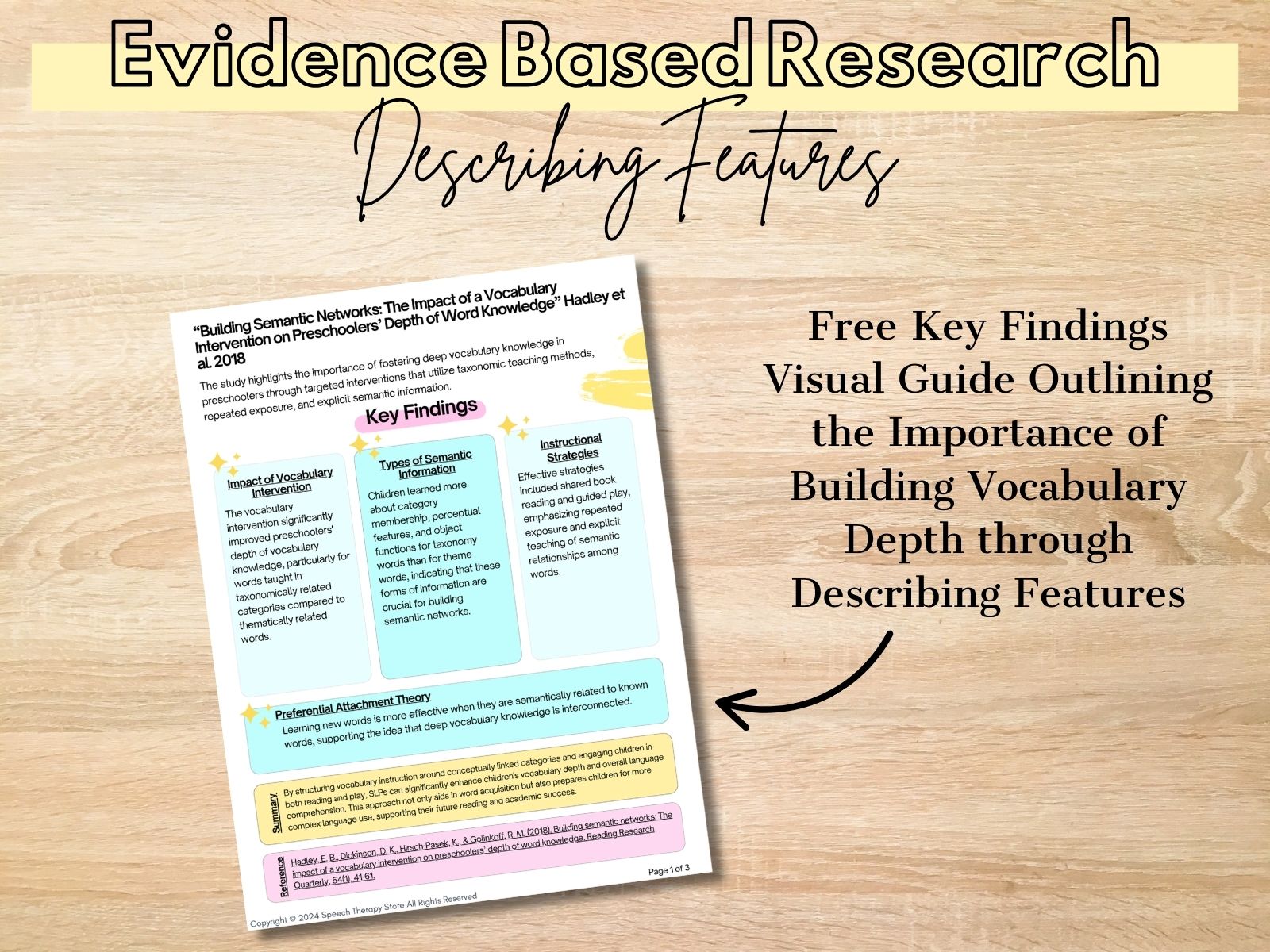
This post is based on Hadley, Dickinson, Hirsh-Pasek, and Golinkoff’s 2018 study, “Building Semantic Networks: The Impact of a Vocabulary Intervention on Preschoolers’ Depth of Word Knowledge.” Check out the research article right here.
At the Speech Therapy Store, we believe therapy should be grounded in evidence-based vocabulary instruction. But we also know most SLPs don’t have time to sit down and read a full journal article between IEPs, sessions, and everything else on a caseload.
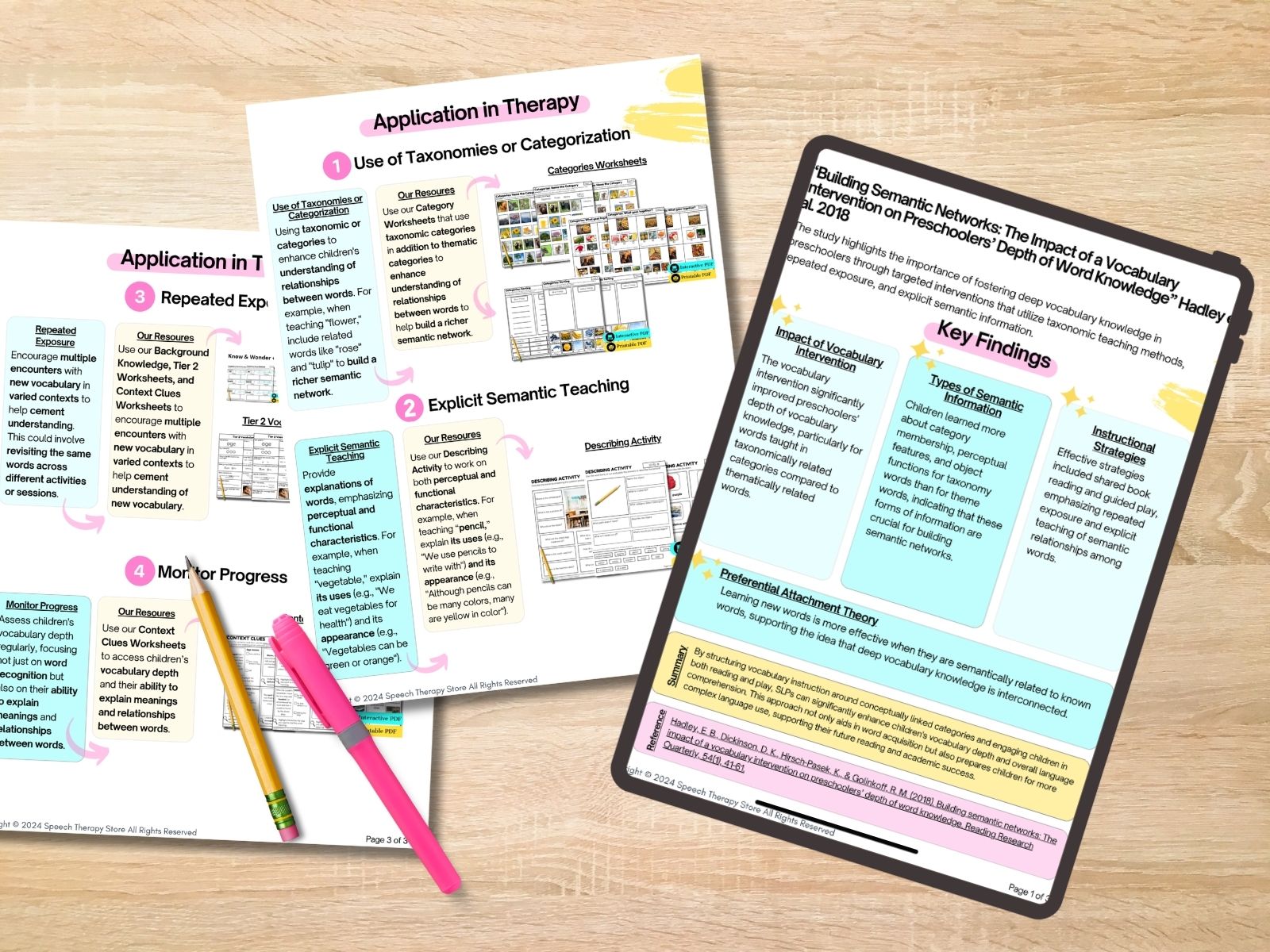
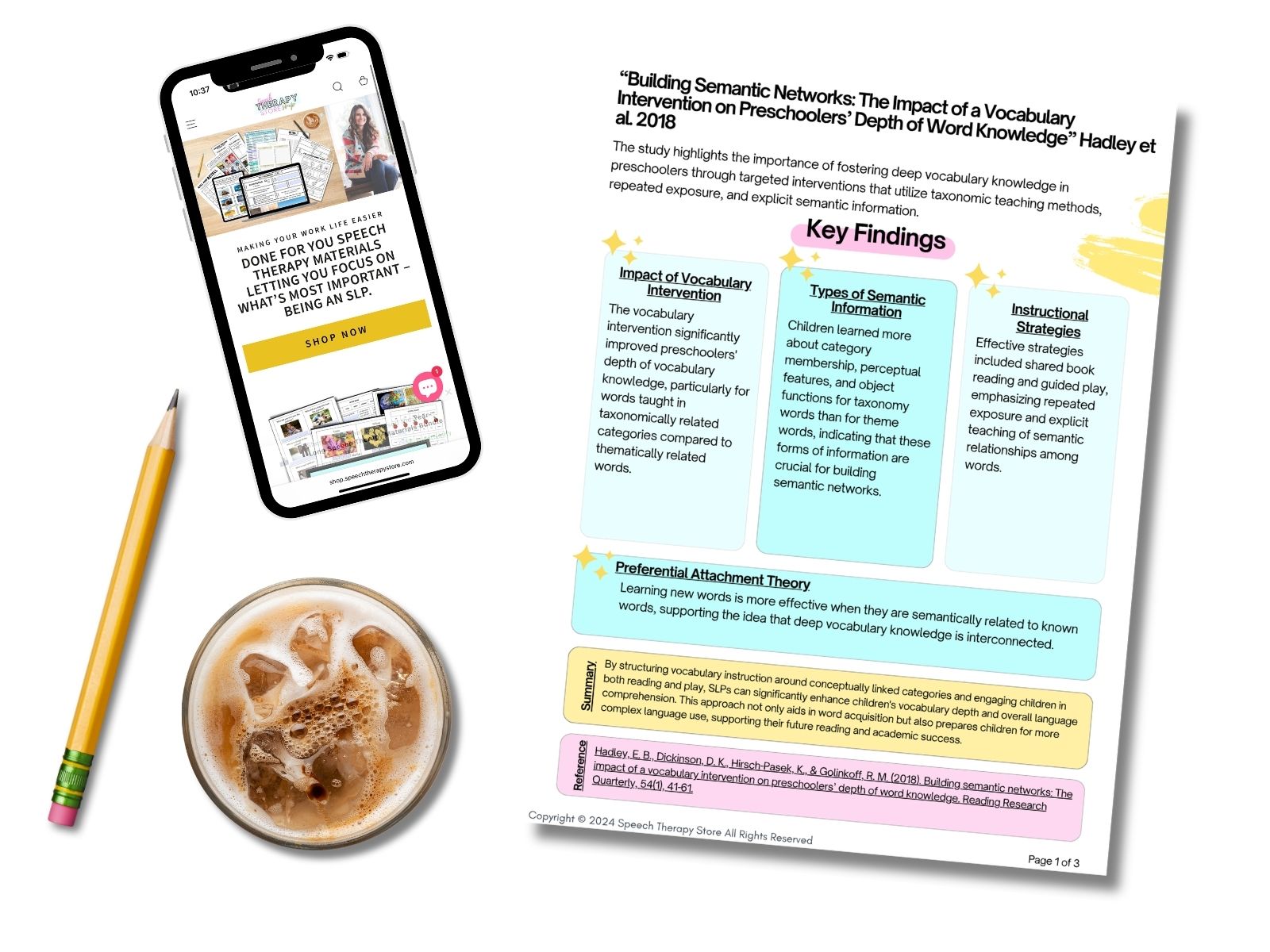
That’s why we built a Key Findings Poster to go along with this post — a plain-language breakdown of what the study found and how to use it in therapy tomorrow, not just reference it later.
👉 Grab the free poster below!
Let’s get into what the research actually says about describing activities and vocabulary.
What Are Describing Activities, and How Do They Help Build Vocabulary?
Describing activities ask a student to go beyond naming a word and explain what it is — its category, what it’s used for, what it looks like, where you’d find it, and what parts make it up.
That distinction matters more than it sounds like it should. The research found that vocabulary instruction significantly improved when kids were taught to describe a word’s perceptual and functional characteristics — not just given a one-line definition.
Take the word “pencil.” A dictionary-style definition might stop at “a tool for writing.” Explicit, describing-based instruction goes further:
- Function: “We use pencils to write with.”
- Perceptual features: “Pencils can be many colors, but a lot of them are yellow.”
- Category: What group does it belong to — school supplies, tools, art materials?
Kids in the study who were taught this way didn’t just recognize more words — they knew more about each word. Depth of knowledge nearly quadrupled from pretest to posttest, going from an average of 0.3 pieces of information per word to 1.2 after intervention. That’s the difference describing activities are designed to build: not just wider vocabulary, but deeper vocabulary.
Curious how this connects to categorization and semantic networks? We cover that angle in Semantic Networks in Speech Therapy: What the Research Says — this post focuses specifically on the describing piece.
What Happens When Kids Only Get Surface-Level Word Knowledge?
When vocabulary instruction stops at a name or a one-line definition, students end up with vocabulary that’s wide but shallow — lots of words, not much attached to any of them.
You might see this show up as:
- being able to label a picture but not describe it
- vague or generic descriptions (“it’s a thing you use”)
- difficulty answering “what does it look like” or “what is it for” questions
- trouble making inferences or connections between related words
- vocabulary that doesn’t transfer well into reading comprehension
This tracks with what the research found: without explicit, structured describing instruction, students’ word knowledge tends to stay surface-level — enough to recognize a word, but not enough to reason with it. And since reading comprehension and expressive language both lean heavily on how well-connected and detailed a student’s word knowledge is, shallow vocabulary quietly limits a lot more than vocabulary tests. Strengthening categorization skills alongside describing is one of the fastest ways to help students notice how words relate to each other.
How Describing Activities Build Vocabulary (Evidence-Aligned Strategies)
Here’s what the research points to as the most effective ways to bring describing activities into your therapy sessions:
1. Teach perceptual and functional characteristics explicitly.
Don’t stop at a definition. When you introduce a new word, walk through what it looks like and what it’s used for. For “vegetable”: “We eat vegetables to stay healthy” (function) and “vegetables can be green, orange, or red” (perceptual feature). This pairs well with choosing high-utility Tier 2 vocabulary words to teach this way first.
2. Use repeated exposure across different contexts.
One exposure to a word — even a well-described one — isn’t enough. The research emphasizes multiple encounters with the same word across different activities and sessions to help the description actually stick.
3. Assess more than recognition.
Instead of only checking whether a student can point to or name a picture, ask them to describe it. Can they tell you its category, its function, and its features? That’s a much better measure of depth than a simple identification task.
4. Pair describing with shared reading and play.
The study found that describing instruction was especially effective when it happened during shared book reading and guided play — not just isolated drill work. Weaving describing prompts into a story or an activity gives students a natural reason to use the language.
Conclusion + Free EBR Key Findings
Teaching a word’s name is only step one. If we want students to really know a word — to use it, reason with it, and connect it to what they already understand — describing activities need to be part of the plan, not an afterthought.
Grab the free Key Findings Poster below and keep it close as a reminder to build describing into your vocabulary instruction, not just naming and labeling.

🧩 What This Looks Like in Real Therapy
Once you start looking for it, the “name it and move on” pattern shows up everywhere in vocabulary instruction — and it’s an easy one to shift.
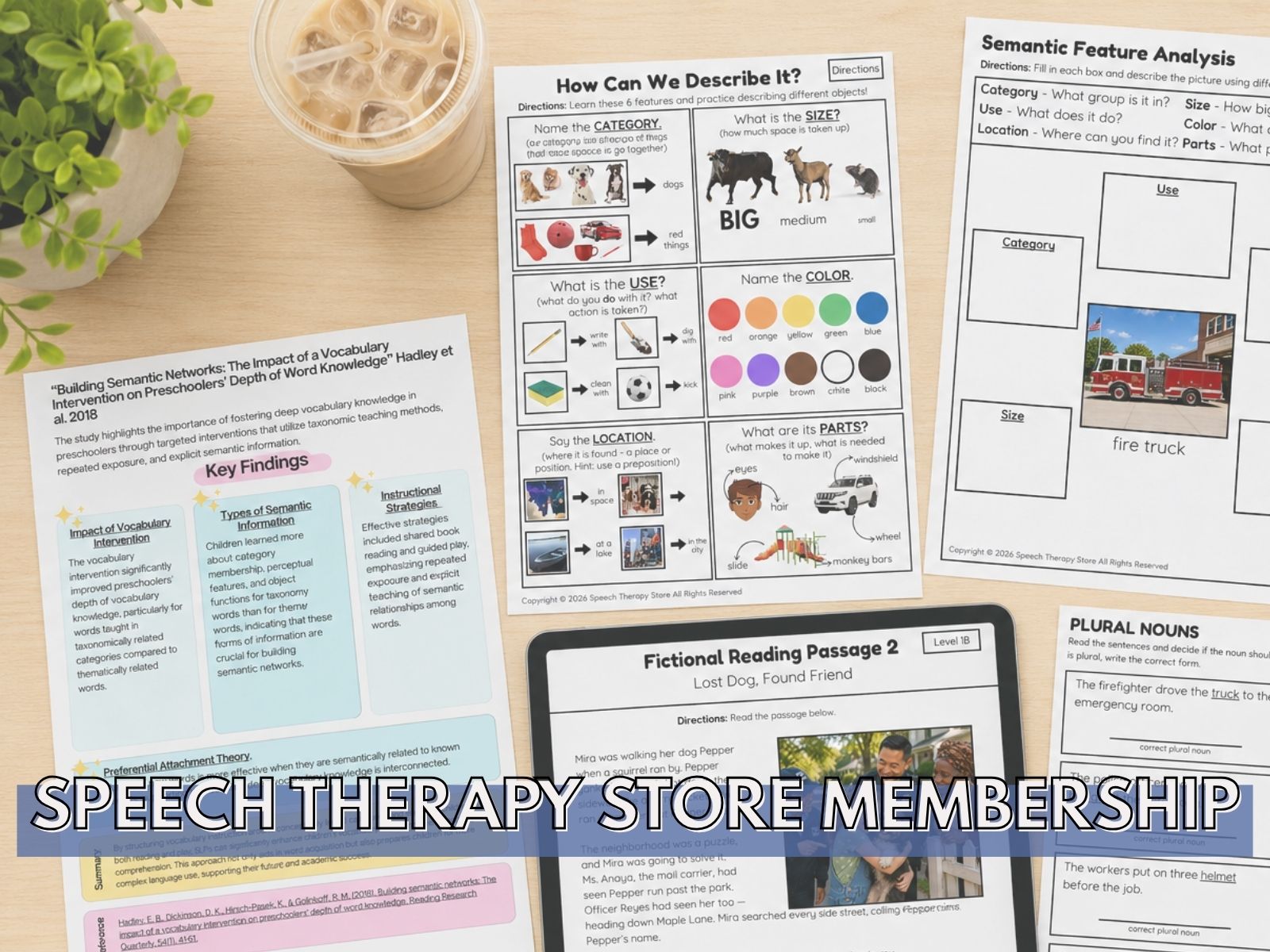
Inside the Speech Therapy Store Membership, our Describing Activity resource is built directly around this research. Instead of asking students to simply label an item, they work through its category, use, location, size, color, and parts — the exact perceptual and functional characteristics the research points to.
Students don’t just walk away knowing a word exists. They walk away able to describe it, explain it, and connect it — which is what real vocabulary depth looks like in practice. For a broader look at putting these ideas into practice, check out our guide to evidence-based speech therapy strategies.
Learn More Here About The Membership Here!
Reference: Hadley, E. B., Dickinson, D. K., Hirsh-Pasek, K., & Golinkoff, R. M. (2018). Building semantic networks: The impact of a vocabulary intervention on preschoolers’ depth of word knowledge. Reading Research Quarterly, 54(1), 41–61.
Want More Evidence-Based Research?
If today’s post got you thinking about vocabulary depth, here are a few more evidence-based reads to check out:
- Semantic Networks in Speech Therapy: What the Research Says
- Tier 2 Vocabulary Instruction: Evidence-Based Guide + Curriculum
- Vocabulary Building through Context Clues
- Categories In Speech Therapy (How and What to Teach)
- Evidence-Based Speech Therapy Strategies Made Simple
And if you’re looking for grab-and-go games and resources just to practice categories, these have been favorites: