In the last post, I showed you the research web: how narrative, vocabulary, comprehension, and morphology aren’t four separate language skills, but one connected system. That post was the why. This post is the how.
Because knowing the research connects is one thing. Actually building a speech therapy session that hits all four areas, for a real mixed group, in the time you actually have, is another thing entirely. So let’s walk through exactly what that looks like.
One Theme, One Mixed Group
Let’s make this concrete. Picture a real mixed group: a few students working on basic story grammar, one or two ready for more complex vocabulary and inferencing, all of them needing some level of support with morphology. This is a normal Tuesday caseload, not a hypothetical.
The materials for this session come from the County Fair bundle, one of our themed monthly bundles. Like every bundle in the membership, it’s built around one nonfiction article and two fiction stories, all tied to a single theme. That shared theme is what makes it possible to hit all four research areas without the session feeling like four disconnected activities stapled together.
The Five Jobs of One Themed Bundle
Here’s how the five jobs break down across one County Fair session, with the research from the last post baked into each one.
Nonfiction Article — Background Knowledge, Vocabulary, Morphology, Comprehension
The County Fair nonfiction article does the heaviest lifting in the bundle. Before anyone touches a comprehension question, the article has already built the background knowledge Elleman and Oslund (2019) say comprehension depends on. The same article carries this month’s six Tier 2 vocabulary words, woven through the text rather than bolted onto a glossary page. And because the article is packed with themed language, it naturally surfaces the kind of morphologically rich words a student is likely to encounter in real reading — the words we pull into the morphology activity so students can practice taking them apart into roots and affixes.
Vocabulary — The Word Wall, the Writing Activity, the Retell
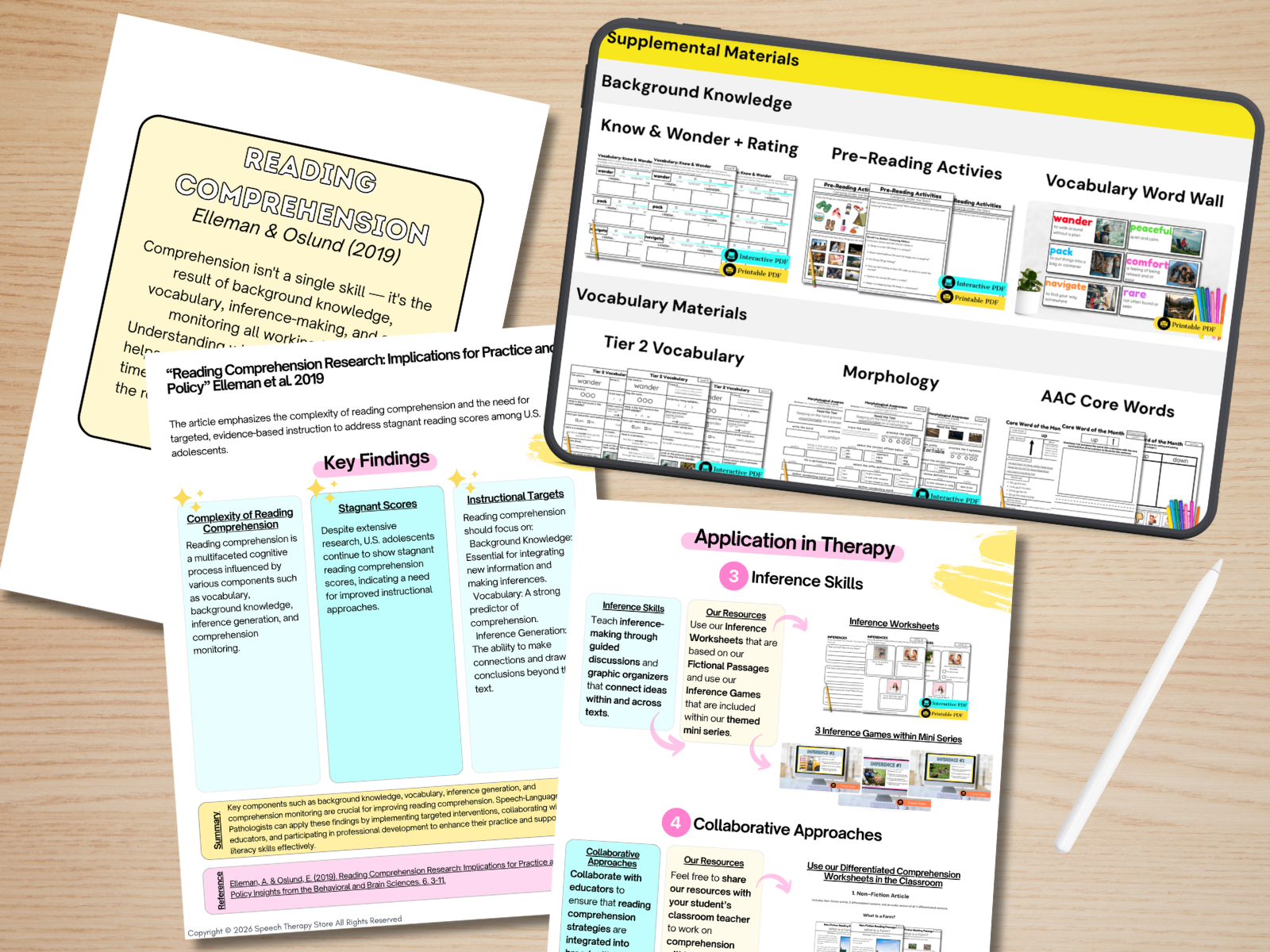
The six Tier 2 words for this theme show up everywhere on purpose. They’re on the word wall before the session starts. They show up again in the making-connections activity, where students engage with each word in six different ways — writing it in their own definition, using it in a sentence, sorting it into a category, connecting it to their own life, and answering an open-ended question that pushes them to actually use the word to think, not just recognize it. And they show up a third time in a short writing activity where students use the word in a sentence about the fair. Beck, McKeown, and Kucan (2013) call this the writing-and-vocabulary link, and it’s why the writing activity exists at all: writing is one more meaningful encounter with the word, not a separate language arts task bolted onto a speech session.
Then comes the fourth encounter, and it’s the one that actually tests whether the word stuck: during the story retell, the student is nudged to stretch and use the target word themselves, even though it never appears in the fiction story. That’s the moment McKeown (2019) is describing when she talks about active, engaged vocabulary practice rather than passive definition memorization. The student isn’t reciting a definition back. They’re reaching for the word because the moment in the story calls for it.
Morphology — Themed Words in Real Context
Morphology gets its own moment, but it doesn’t get its own vocabulary drill. This month, the featured word is a themed word built around an affix worth learning — not necessarily a word from the article, but one a student would realistically meet in reading. Students see the word inside a sentence first, take it apart into root and affix, and then work with it in context.
From there, we do something the isolated-worksheet approach can’t. We use morphemes in context: one target prefix or suffix woven across multiple words inside a short story. Students see the same affix show up in three or four different words as the story unfolds — same meaning, different roots, different sentences — so they’re not memorizing one word with a suffix. They’re building the pattern.
This matters most for the students in the group who struggle hardest with grammatical morphology, which Moraleda-Sepúlveda and López-Resa (2022) found to be a real, measurable difference across every subarea they tested in students with Developmental Language Disorder. For those students, morphology isn’t a bonus skill. It’s often the thing standing between them and a word’s full meaning, especially with verb tense and form. Giving them repeated exposures to the same affix across multiple themed words, inside a story that carries the meaning, gives them more chances to close that gap than one isolated worksheet ever could.
Comprehension — One Piece of the Puzzle
By the time comprehension questions actually come up, most of the work is already done. The background knowledge is built. The vocabulary has had three encounters. That’s the point Elleman and Oslund (2019) keep making: comprehension isn’t a standalone skill you teach in its own block. It’s the sum of everything that came before it. So this job gets the shortest section here on purpose. It’s not less important. It’s just less visible, because it’s been happening the whole session.
Narrative — Two Fiction Stories, Story Elements, and Compare-and-Contrast
The two fiction stories carry the fourth job, narrative, and they’re where the retell from the vocabulary section actually happens. Students work through each story’s grammar elements — the same character, problem, feeling, action, ending structure Spencer and Petersen (2020) describe as the foundation for narrative intervention. Then they compare and contrast the two stories against each other: same theme, two different characters facing two different problems.
This is exactly where the mixed group earns its name. The student still working on basic story grammar gets to practice naming the parts of the story. The student ready for more gets pushed into the inferencing work that Spencer, Kirby, and Petersen (2024) found students retain when it’s embedded in a narrative they’re actually telling. And for the students with the biggest narrative gap, the ones Winters and colleagues (2022) found score furthest behind their peers on story grammar, this is the highest-leverage ten minutes of the whole session.
Here’s the Catch
So that’s the session. Five jobs, 1 non-fictional article, two fictional passages, one theme, every research area covered, and a mixed group meeting each student where they are. Any SLP reading this already knows narrative, vocabulary, morphology, and comprehension should connect. That’s not the hard part.
The hard part is everything I just described took someone hours to build. A themed nonfiction article and two fictional stories, written to share a theme. Tier 2 words chosen and woven throughout. Morphologically rich themed words used and turned into an activity. Comprehension questions sequenced so the background knowledge actually lands. Story grammar elements mapped, scaffolded, and leveled three different ways so the same lesson works for a student who needs heavy support and a student who’s ready for independent inferencing.
That’s not a Tuesday-night task. That’s a week’s worth of work, every week, for one mixed group, out of however many groups are on your caseload.
💛 This Is What the Membership Hands You – Already Built
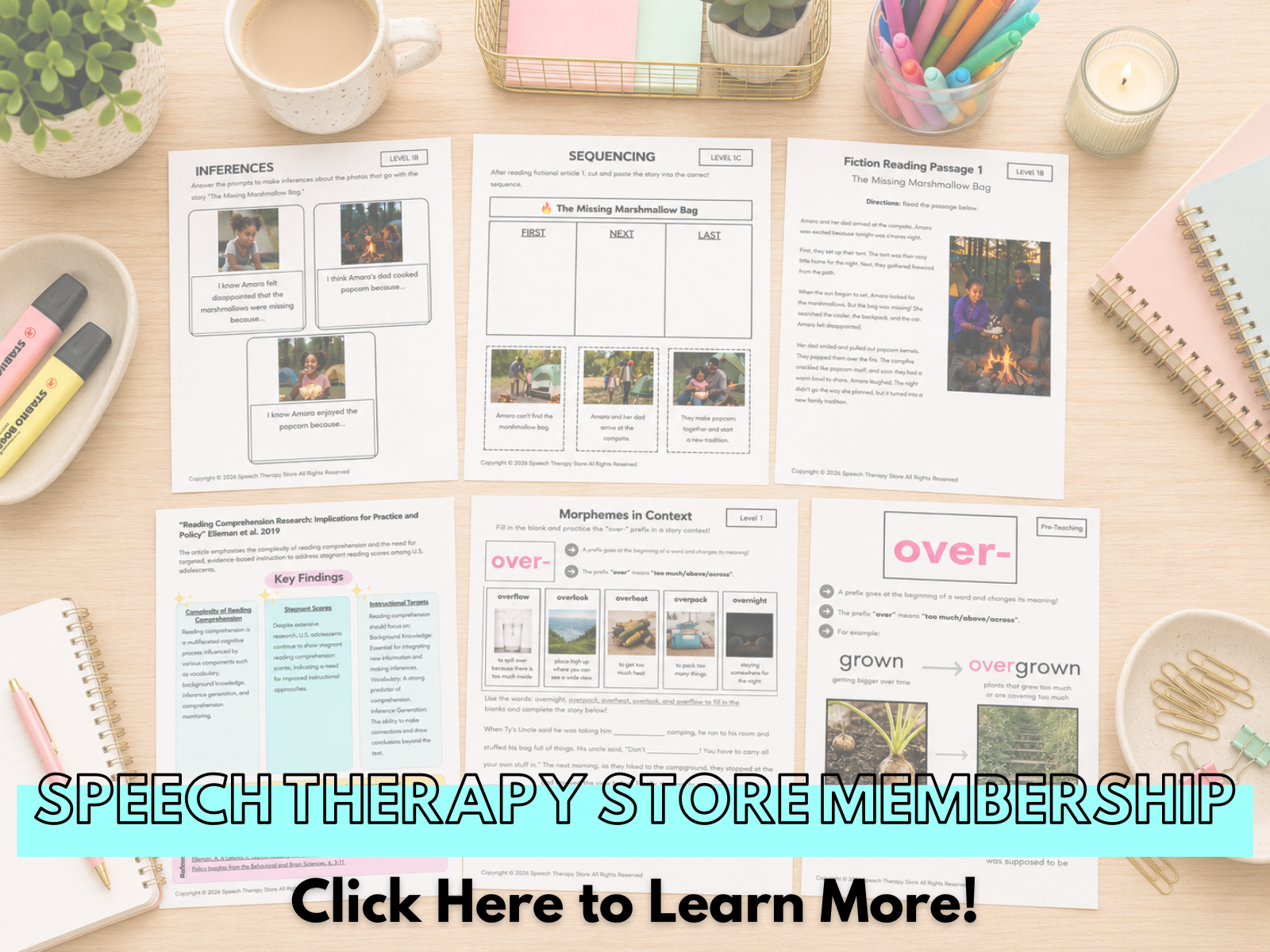
Every themed bundle in our evidence-based speech therapy membership is built exactly the way the County Fair session was: one non-fictional article and two passages sharing one theme, Tier 2 vocabulary woven throughout, morphologically rich themed words used, comprehension sequenced to use the background knowledge that’s already there, and story elements mapped for the narrative side. All of it differentiated three ways, Level 1, Level 1B, and Level 1C, so the mixed group you actually have is the mixed group the materials were built for.
The research doesn’t change whether you build the materials yourself or whether they’re already waiting for you. The only thing that changes is your Tuesday night therapy planning scramble. Come see what’s inside our speech therapy membership →
🎁 Your Free Download: The Application in Therapy Maps
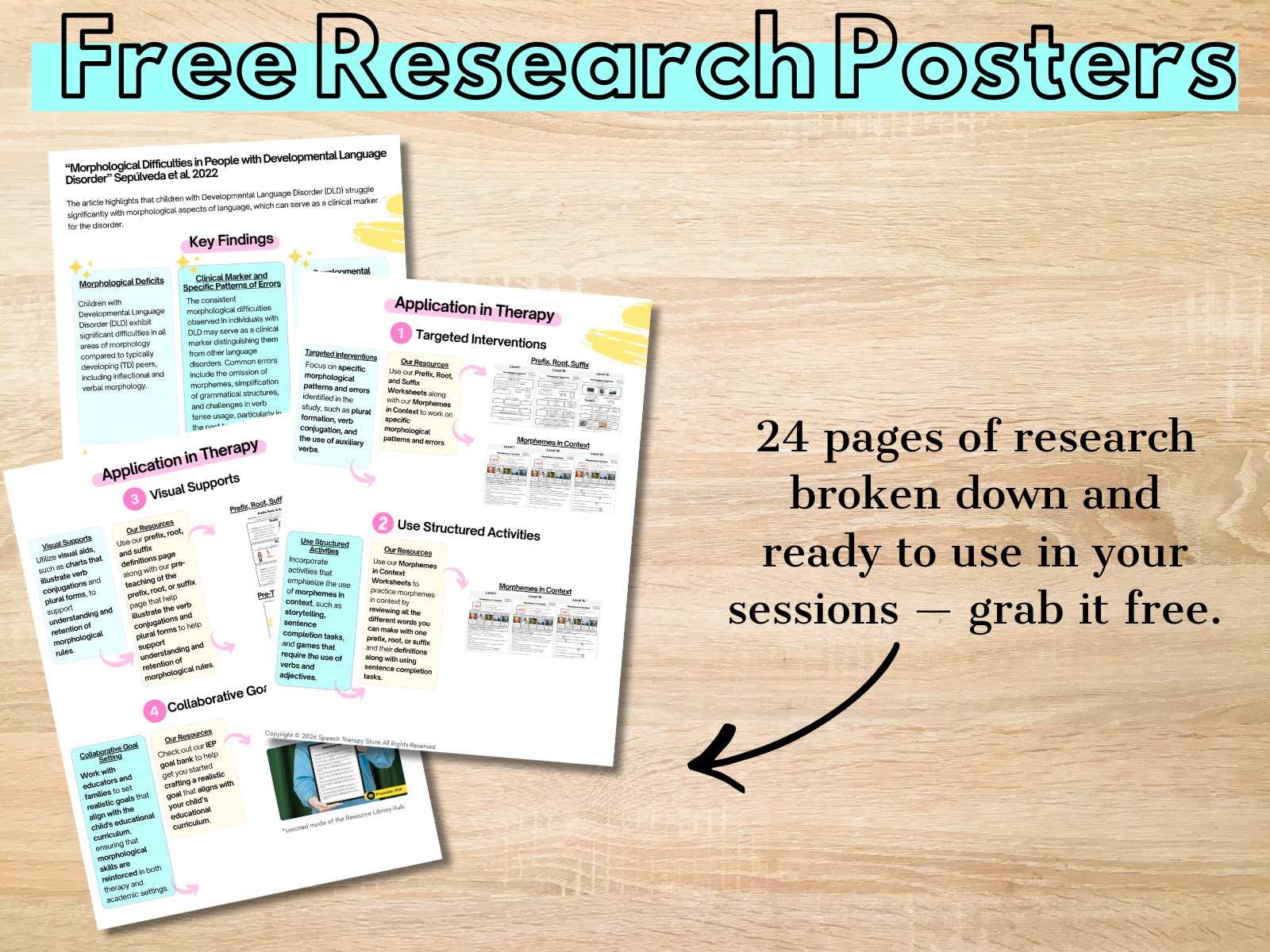
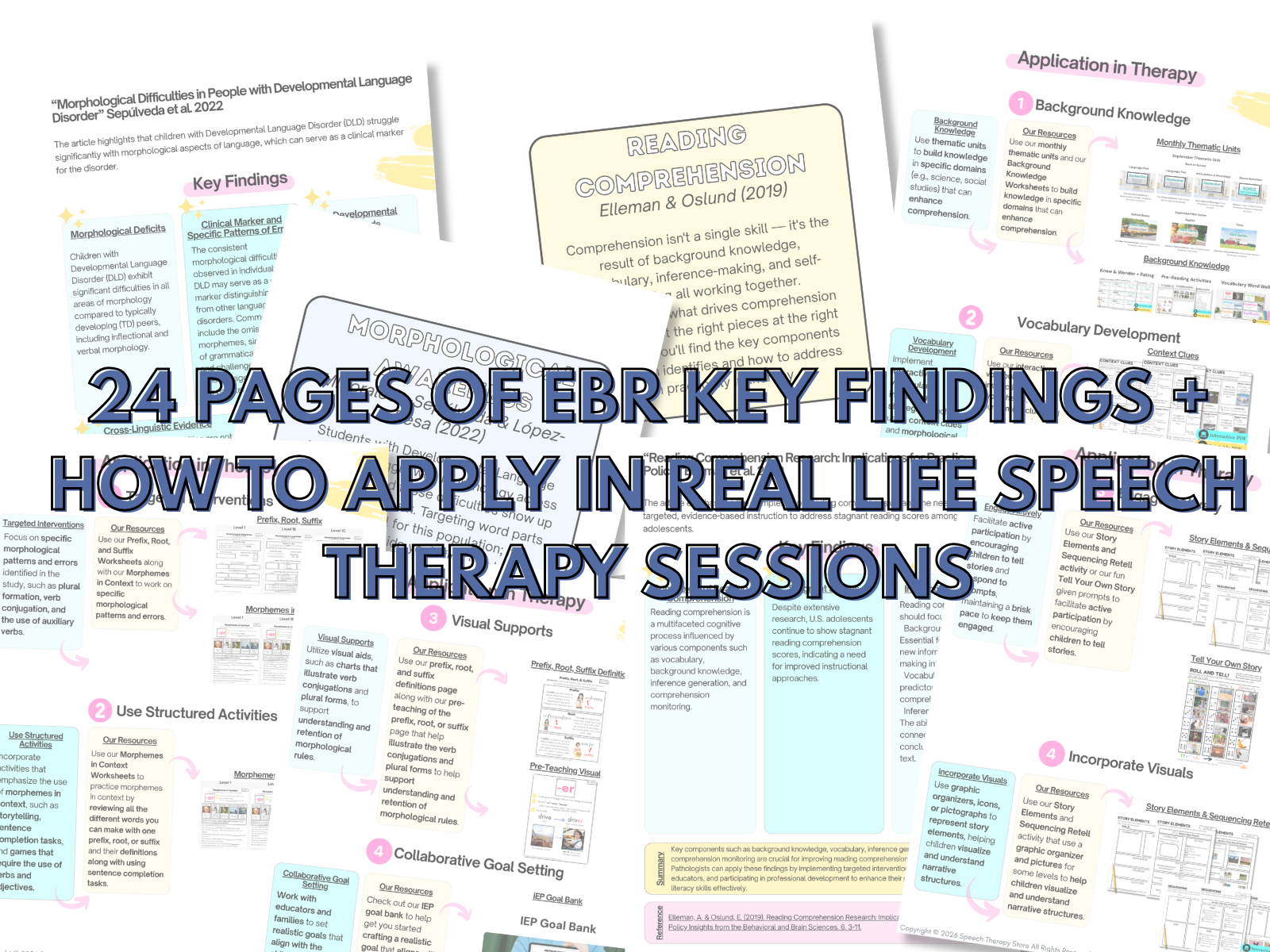
I made you a set of Application in Therapy Maps: one research page plus two application pages for each of the four areas from the post. The application pages are the part we normally hold back for just members. This time, they’re yours free.
Grab it below. It’s free, and it’s yours to keep.

🌟 The Research Doesn’t Fail You. The Hours Do.
Every SLP I know already wants to teach this way. Connected, evidence-based, leveled for the whole mixed group, built around real research instead of whatever’s free on a Sunday night search. The research has never been the obstacle. The hours it takes to turn that research into Tuesday’s session, week after week, is the obstacle.
Grab your free Application in Therapy Maps above and put this session’s structure to work on your own caseload this week.
Next time, we’ll go even further into how to differentiate this same kind of session by goal and by level, so every student in the room is working from the same lesson without anyone doing the same worksheet. See you there. 💛