
We were trained to split them up. Narrative. Vocabulary. Comprehension. Morphology. Four language skills, four worksheets, four tidy little boxes, each one taught and tracked on its own.
But here’s what the speech therapy research has been arguing for years: these aren’t four separate language skills. They’re one, wearing four name tags. The narrative intervention research points straight at vocabulary. The vocabulary research circles back to comprehension. And comprehension? It pulls in all of it. These are threads in the same piece of fabric, and once you see the weave, you can’t unsee it.
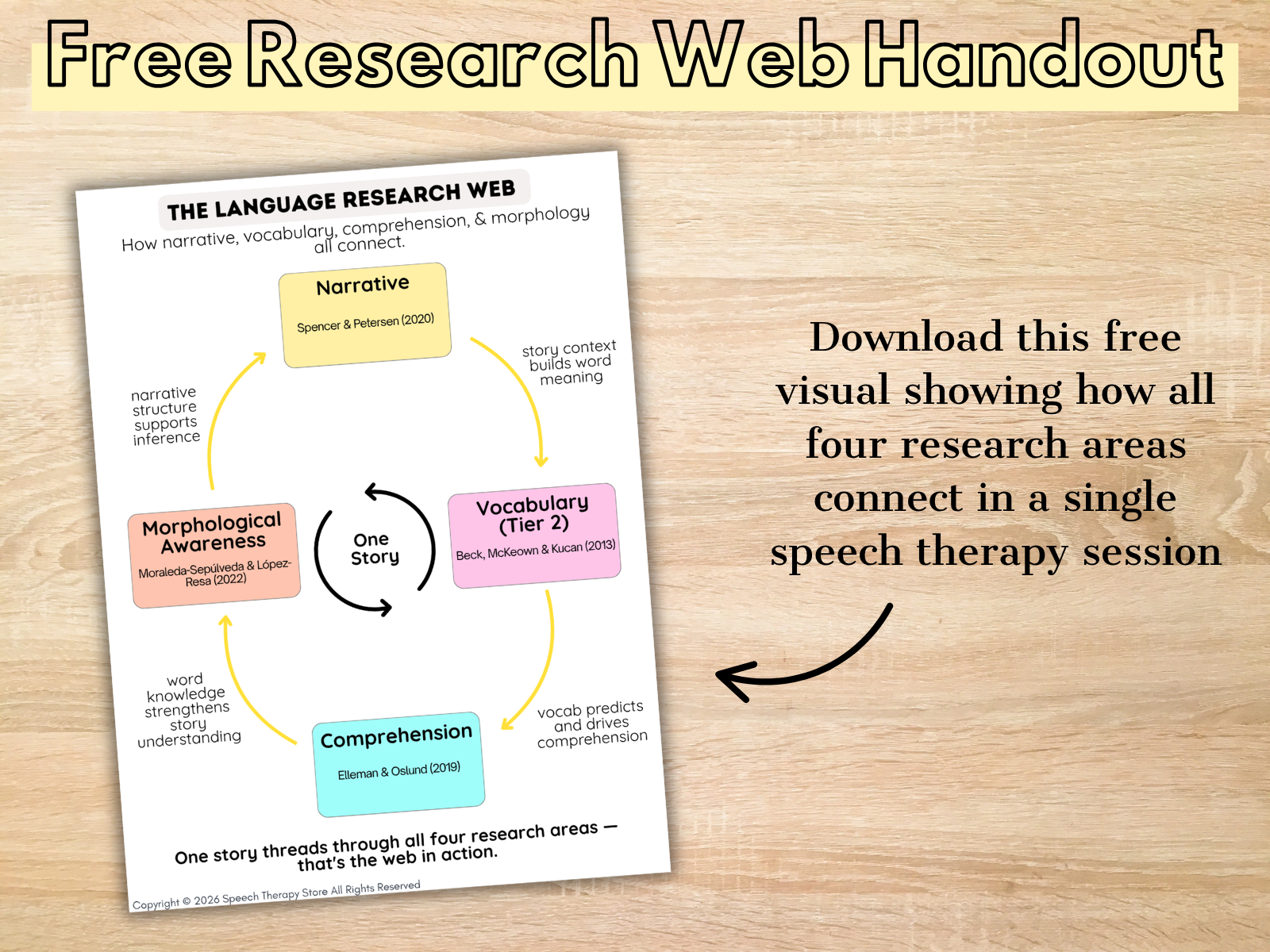
Which matters for how you plan therapy. Because if the research treats these language skills as connected, your sessions get to be connected too. Below, you’ll find what the evidence-based research actually says about each skill area, plus the part that usually gets left out: how narrative, vocabulary, comprehension, and morphology weave together. I also made you a free one-page Research Web so you can see all of it at a glance — and keep it handy for the next time someone asks why your sessions look the way they do.
📚 Want the Deep Dive on Any One of These Language Skills?
I’ve written full posts on each of these language and literacy skill areas already. This one is the bird’s-eye view of how they connect, but if you want to go deep on a single thread, start here:
Narrative Intervention in Speech Therapy. Why storytelling is one of the highest-leverage things you can target. (read it here)
Tier 2 Vocabulary Instruction. The words that bridge everyday talk and academic language. (read it here)
Reading & Story Comprehension. What’s really going on when comprehension stalls. (read it here)
Morphological Awareness. Teaching the meaningful parts of words to unlock the rest. (read it here)
🔍 What the Evidence-Based Speech Therapy Research Actually Says
Here’s the short, plain-language version of each language skill: the named study, the findings that matter, and why they’d change how you plan therapy.
Narrative — Spencer & Petersen (2020)
In Narrative Intervention: Principles to Practice (Spencer & Petersen, 2020), the authors lay out why narrative intervention is such a powerhouse for building connected language skills.
Narrative intervention improves multiple language skills at once: story grammar, complex sentences, vocabulary, inferencing, and social pragmatics.
Storytelling itself is the therapy. Producing and retelling stories strengthens both comprehension and expression.
A handful of guiding principles make it work: build story structure first, use visuals, keep kids actively participating, and give immediate feedback.
Here’s what jumps out at me: that very first finding is the whole argument of this post in one line. The research isn’t saying “narrative helps narrative.” It’s saying narrative is the place where vocabulary, inferencing, and sentence structure all show up together. One activity, many language goals.
In a session, that looks like a student retelling a themed story while you quietly score story grammar, fold in two Tier 2 words from that same theme, and ask one inference question about why a character did what they did. You didn’t run three separate language activities. You ran one story that happened to hit three goals.
Vocabulary (Tier 2) — Beck, McKeown & Kucan (2013)
Bringing Words to Life (Beck, McKeown & Kucan, 2013) is the foundational text on robust vocabulary instruction in speech and language therapy, and the takeaways are refreshingly doable:
Focus on Tier 2 words, the high-utility words that show up across subjects (analyze, compare, observe), not basic words or rare technical ones.
Kids need multiple, meaningful encounters with a word before it sticks. Definitions alone don’t cut it.
Teach words in context, with discussion and real examples, not isolated vocabulary drills.
And notice where “in context” naturally leads. The strongest place to give a word multiple meaningful encounters? Inside a story you’re already telling. Vocabulary instruction doesn’t really want to live on its own page. It wants to live in the narrative.
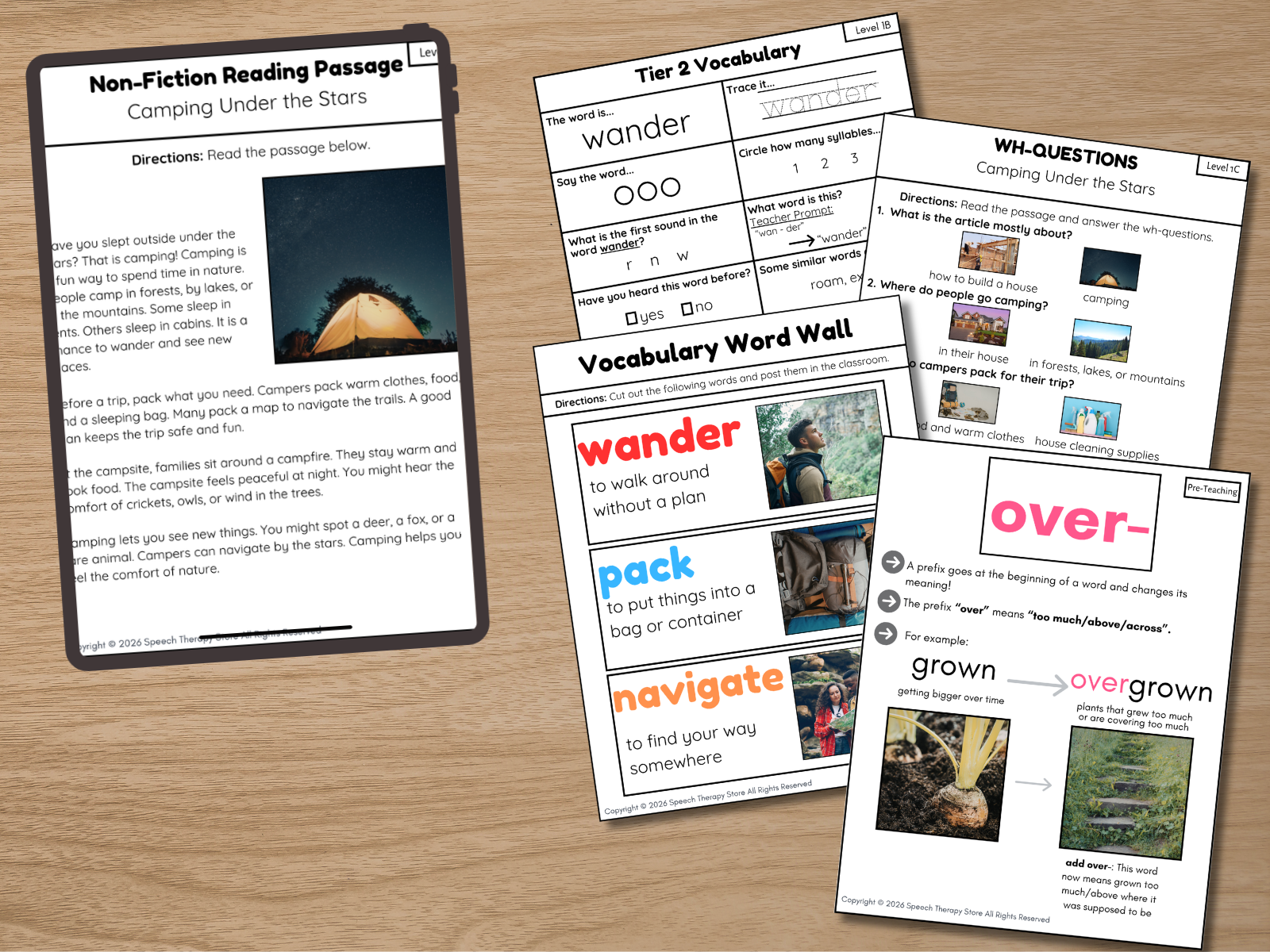
In a session, that looks like one of the week’s two Tier 2 words showing up again and again: in the article, on the word wall, in a making-connections page, in the writing activity. Then, during the story retell, the student is nudged to stretch and use one of those words themselves, even though it never appears in the story. That’s Beck’s “multiple meaningful encounters” built right into the theme, and not a flashcard in sight.
Comprehension — Elleman & Oslund (2019)
Reading Comprehension Research: Implications for Practice and Policy (Elleman & Oslund, 2019) makes the case that reading comprehension isn’t one language skill. It’s a system:
Comprehension is built from several components: background knowledge, vocabulary, inference generation, and comprehension monitoring.
Background knowledge is essential. Kids can’t make inferences about something they know nothing about.
Vocabulary is one of the strongest predictors of whether reading comprehension happens at all.
So comprehension literally has vocabulary and background knowledge baked into its definition. You can’t teach it as a standalone language skill. By design, it reaches into the other three.
In a session, that looks like reading the nonfiction article first so the background knowledge is already in place, then working the comprehension questions and watching kids actually have something to reason from. The article stops being a separate task and becomes the thing that makes the comprehension answerable.
Morphological Awareness — Moraleda-Sepúlveda & López-Resa (2022)
Moraleda-Sepúlveda and López-Resa (2022) looked at morphological difficulties in people with Developmental Language Disorder (DLD), and the findings make a strong case for keeping morphological awareness on your radar:
People with DLD show serious difficulties with grammatical morphology compared to typically developing peers, across all morphological subareas.
Verb morphology takes a particularly hard hit: omitted morphemes, simplified verb forms, and trouble with tense (past tense especially).
Those difficulties are consistent enough that morphology may serve as a clinical marker of DLD.
Here’s why morphological awareness belongs in this same conversation: it’s the system that lets kids unlock words they’ve never seen before. It’s not an “extra” language skill. It’s a foundation that feeds straight into vocabulary and comprehension. A key that opens the vocabulary door, with the comprehension door right behind it.
In a session, that looks like pulling one morphology-rich word from the week’s theme and showing how the parts build the meaning. Not because the word is on the Tier 2 list, but because the skill is transferable — once a student sees how prefixes, suffixes, and roots stack together to make meaning, they can use that same lens on any unfamiliar word they meet later, in a chapter book or a science article or a state test passage. Your morphology minute and your vocabulary minute quietly become the same minute, on the same theme.
Here’s Where the Threads Cross
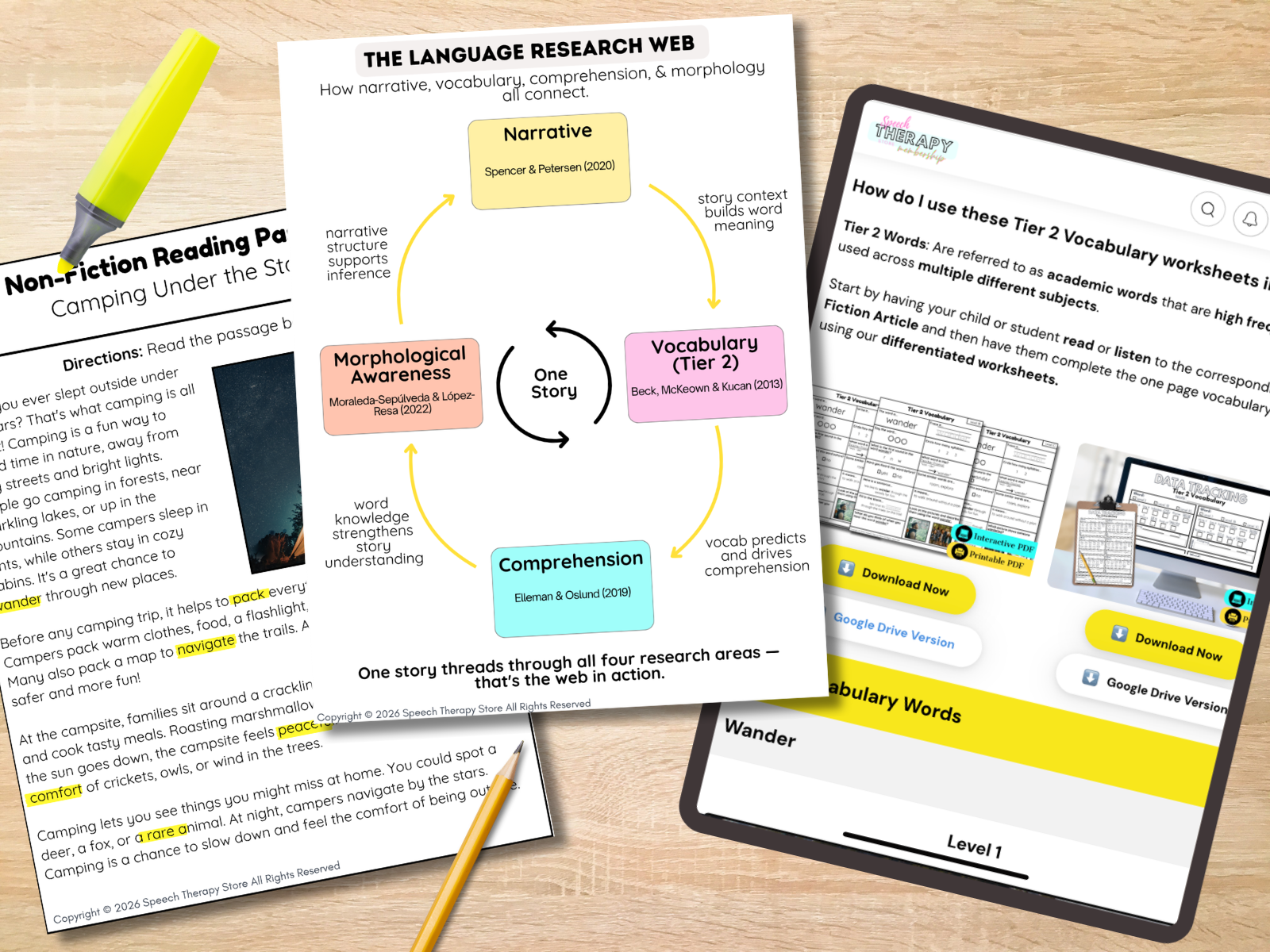
This is the part that’s easy to miss. Look at what happens when you put these studies next to each other instead of in separate folders:
Spencer, Kirby, and Petersen (2024) embedded academic (Tier 2) vocabulary inside a narrative intervention. First graders learned the taught words and retained them over time. Vocabulary and narrative work as one language activity instead of two.
Elleman and Oslund (2019) define comprehension as a blend of background knowledge, vocabulary, inferencing, and monitoring, so the comprehension research is built out of the vocabulary and background-knowledge research.
And Spencer and Petersen (2020) open by saying narrative improves vocabulary, inferencing, and pragmatics together.
Morphology shakes hands with comprehension through vocabulary. Moraleda-Sepúlveda and López-Resa (2022) show how much grammatical word knowledge rides on morphological skill, and Elleman and Oslund (2019) name vocabulary as one of the strongest drivers of comprehension. Teach the word parts, and you’re feeding the comprehension system from upstream.
None of these language and literacy threads stays in its lane. The same handful of studies keep handing off to each other. So when these skills get taught in isolation (a vocab worksheet on Monday, a comprehension page on Thursday, and nothing tying them together), it works against what the research keeps showing us. The magic isn’t in any one thread. It’s in the weave.
💛 How We Bring the Whole Research Web to Life in Our Speech Therapy Membership
This is exactly the problem the Speech Therapy Store Membership was built to solve. Not “here’s a worksheet for narrative, here’s a separate one for vocab,” but evidence-based speech therapy materials designed so the threads stay connected the way the research says they should.
Every month, members of our speech therapy membership get a themed bundle built around one nonfiction article and two fiction stories, all tied to the same theme. The nonfiction article alone carries three of your four research threads at once: it builds background knowledge, teaches the Tier 2 vocabulary, works the morphology, and anchors the comprehension. The two fiction stories carry the fourth, narrative, through story elements, sequencing, and compare-and-contrast. One theme, three passages, every language skill covered. The connections aren’t an accident; they’re the design.
And every piece is differentiated three ways (Level 1, Level 1B, and Level 1C) so the same connected lesson meets each student where they are. That’s 575+ pages a month of evidence-based speech therapy materials that started with the research and ended up as something you can actually pull out on a Tuesday.
It’s the difference between knowing the research and having the research already built for you. Come see what’s inside our speech therapy membership →

🎁 Your Free Download: The Research Web
I made you the one thing I wish I’d had back in my own therapy room: a single page that shows how all four of these language and literacy research areas connect, with the study behind each one.
Here’s what makes it different from the individual research summaries you may have grabbed before. Those each covered one thread. This one shows the weave: narrative, vocabulary, comprehension, and morphology, and exactly how the research hands off between them. It’s the picture, not the four puzzle pieces.
Use it to:
- Anchor your planning when you’re building (or choosing) connected speech therapy materials
- Explain to a teacher, parent, or admin why your sessions look the way they do
- Keep the big picture in view when it’s easy to get lost in one language skill at a time
Grab it below. It’s free, and it’s yours to keep.
🌟 Bringing It Together
So here’s the takeaway, the thread running through everything above: narrative, vocabulary, comprehension, and morphology aren’t four separate language skills. They’re one connected system, and the research keeps proving it. When you teach them woven together, you’re not just being efficient. You’re practicing evidence-based speech therapy.
Grab your free Research Web above so you’ve got the whole picture in one place.
And next time, I’ll take this one step further. Knowing the research connects is one thing. Actually applying it across a real caseload is another. In the next post, I’ll walk you through exactly how to put these four threads into practice in a single session. See you there. 💛