
Many students can say words… but they don’t always have a strong understanding of how those words relate to each other. And that’s where we start to see breakdowns in language, word retrieval, and comprehension.
Research shows that vocabulary knowledge isn’t just about knowing individual words—it’s about how those words are organized and connected in the brain.
In this post, we’re going to break down what this means in a practical, therapy-friendly way. We will cover:
- what semantic organization actually is
- what happens when it’s weak
- how categorization and word relationships strengthen language skills
- what this looks like in real therapy sessions
This post is based on “Lexical–Semantic Organization in Children With Specific Language Impairment” by Sheng & McGregor (2010). Check out the research article right here.
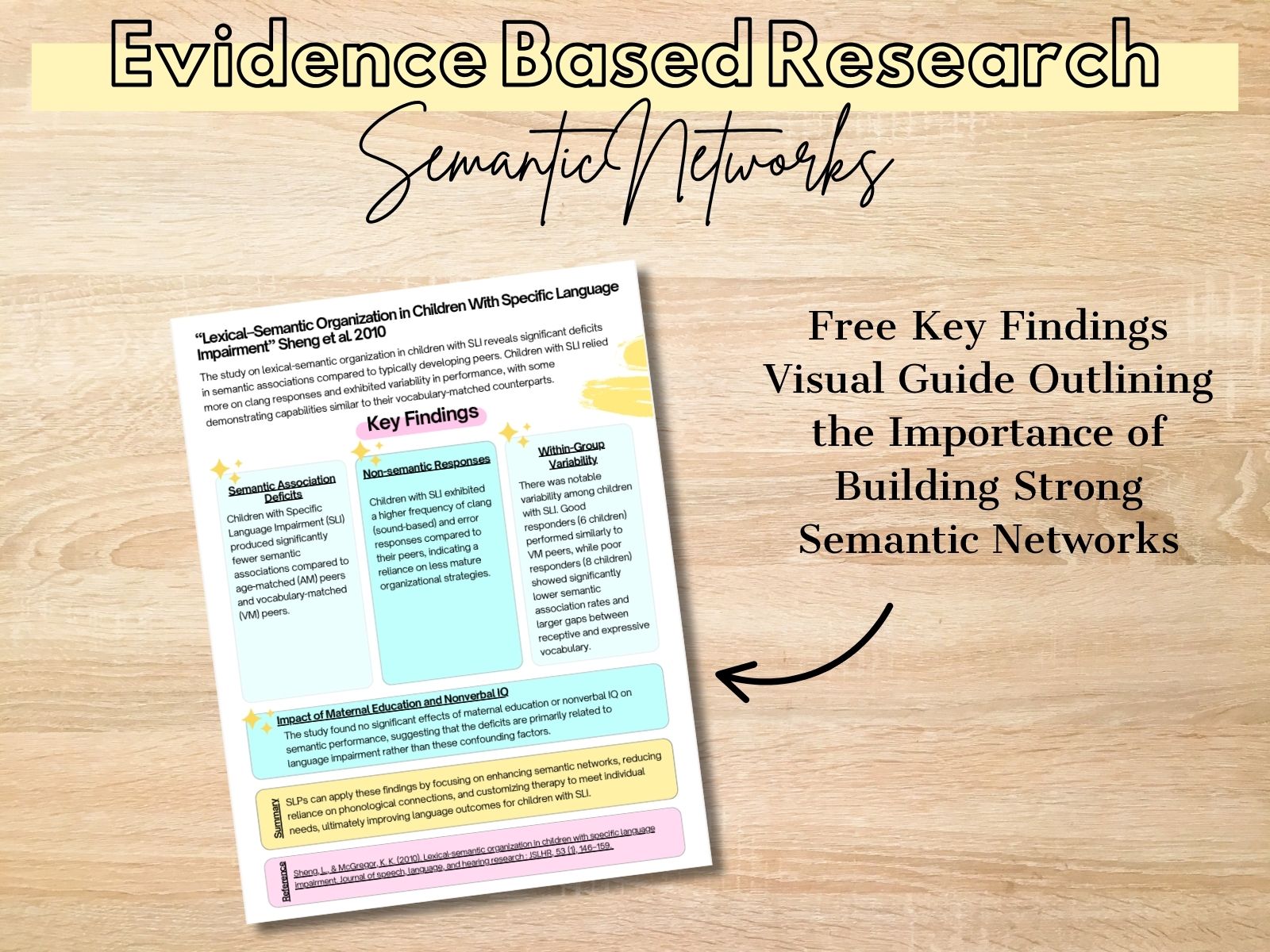
A QUICK NOTE ON THE RESEARCH
This post is based on “Lexical–Semantic Organization in Children With Specific Language Impairment” by Sheng & McGregor (2010), which explores how students with language difficulties organize and connect words in their mental lexicon.
At the Speech Therapy Store, we strongly believe that speech therapy practices should be aligned with what the evidence-based research is telling us. But we also know that, in reality, most SLPs don’t have the time to sit down and read through full research articles—especially when you’re managing a full caseload and trying to plan effective, engaging sessions.
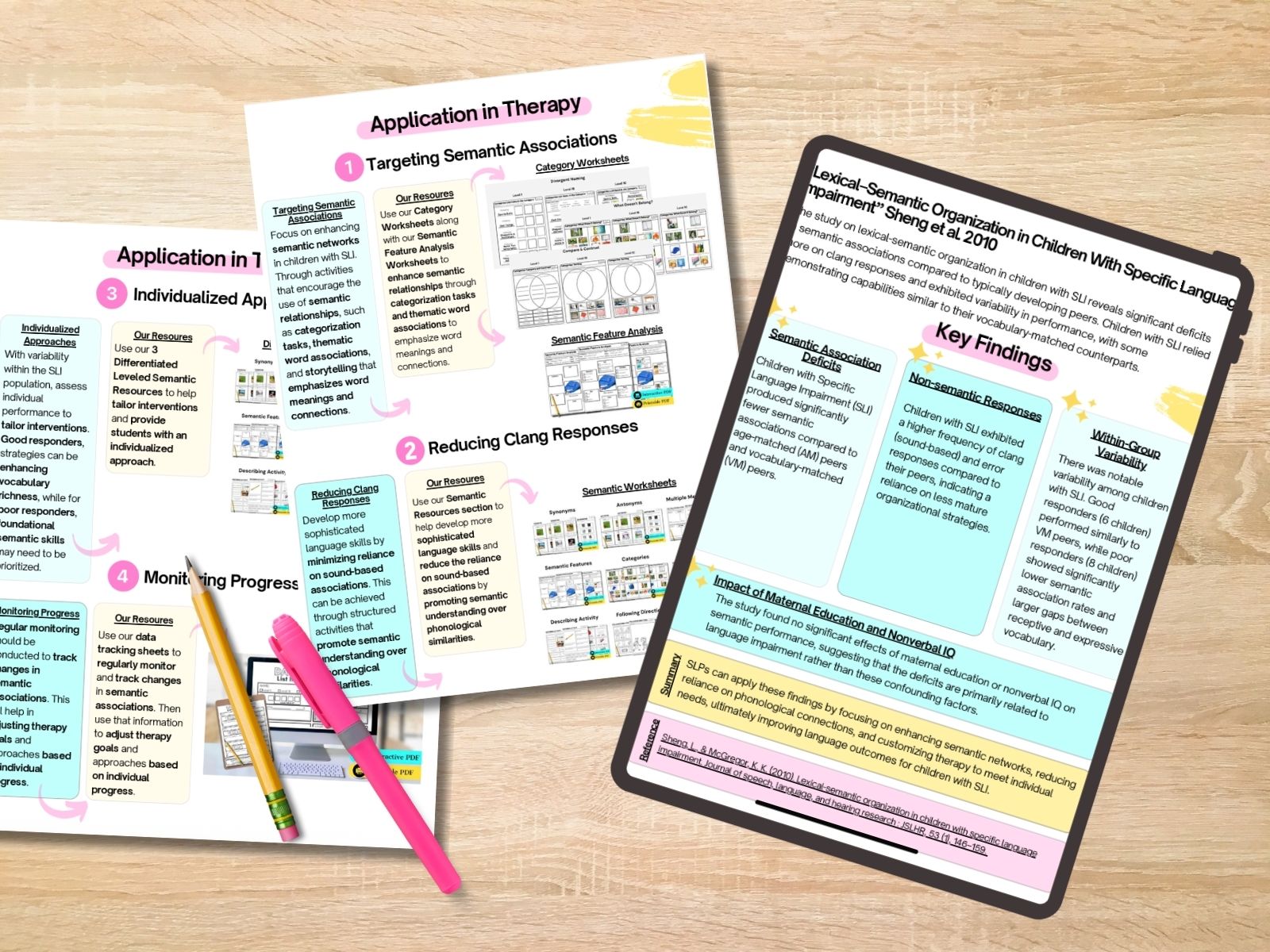
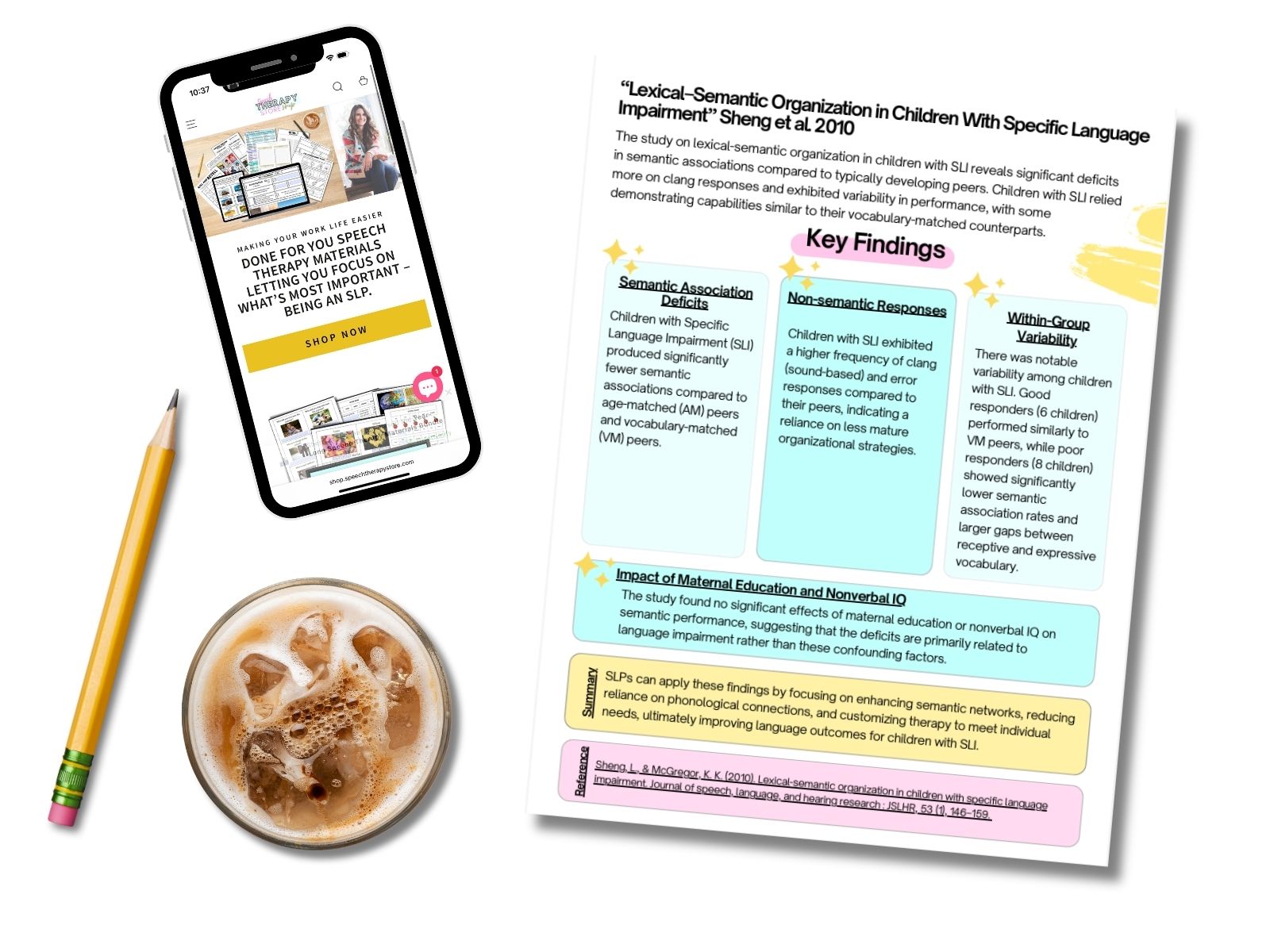
That’s why we created a Key Findings Poster to go along with this post.
Our goal is to take the research and break it down into a clear, practical format that you can actually use in your day-to-day therapy. Instead of sorting through dense articles, you’ll have access to the most important takeaways in a simple, easy-to-read way.
👉 You can download the Key Findings Poster below!
You might choose to:
- print it and keep it in your therapy space
- use it as a quick reference while planning sessions
- share it with teachers or support staff
- or even use it to help explain your therapy goals to families
Because at the end of the day, the more we can connect research to real-life practice, the more confident and effective we can be in supporting our students.
Alright—let’s dive into what the research says about semantic organization in speech therapy.
WHAT IS SEMANTIC ORGANIZATION IN SPEECH THERAPY?
Semantic organization refers to how the brain stores and connects words by meaning.
Rather than being stored randomly, words are grouped into networks based on their relationships to one another. These relationships can include categories, features, function, and context.
Research in language development emphasizes that students need more than exposure to vocabulary—they need opportunities to build meaningful connections between words. These connections form what are known as semantic networks.
You can think of this like a web. Each word is connected to other related words, and the more connections a student has, the stronger that word becomes.
For example, the word apple might connect to:
- fruit
- food
- red
- grows on trees
- something you eat
When these connections are strong, students are better able to:
- understand language
- retrieve words
- describe ideas
- and make sense of what they hear and read
FOR YOU! Looking for more research on Vocabulary in Speech Therapy? We love this topic! Check out what the latest research says on Tier 2 Vocabulary Instruction, Embedded Vocabulary Instruction, and Vocabulary Building through Context Clues.
WHAT HAPPENS WHEN SEMANTIC ORGANIZATION IS WEAK?
When semantic organization is weak, students are not building strong, meaningful connections between words.
Research shows that students with language impairments often have fewer semantic associations and more difficulty organizing words in meaningful ways. Instead of connecting words by meaning, they may rely on surface-level features, such as how words sound.
For example, a student might:
- group words that rhyme instead of words that belong together
- give unrelated or inconsistent responses
- struggle to name items in a category
- have difficulty describing or comparing items
You might also notice:
- limited or vague vocabulary
- difficulty answering WH questions
- challenges with word retrieval (“I know it, but I can’t say it”)
- inconsistent performance across tasks
In some cases, students may produce what are called “clang” responses, where words are connected based on sound rather than meaning. This is a clear sign that semantic networks are not yet strongly developed.
All of this impacts more than just vocabulary—it directly affects comprehension.
When students don’t have strong semantic networks:
- they have a harder time understanding text
- they struggle to make inferences
- they may not recognize relationships between ideas
- and they often have difficulty retaining information
This is why simply teaching individual vocabulary words isn’t enough.
Students need structured opportunities to build and strengthen the relationships between words—and that’s where categorization comes in.
How Categorization Helps Students Build Stronger Language Skills
Categorization is one of the most powerful tools we have for strengthening semantic networks. When students sort, compare, and group words by meaning, they are actively building the mental connections that research shows are weak in students with language impairment.
Here are three simple, evidence-aligned ways to bring categorization into your therapy sessions:
1. Sort by category, then by feature. Start with broad categories (animals, food, clothing) and then push deeper by sorting the same items by feature—what they look like, where you find them, what they do. This forces students to notice multiple relationships between the same words.
2. Use compare-and-contrast pairs. Choose two items from the same category (apple/orange, dog/cat, bus/car) and have students name three ways they are alike and three ways they are different. This builds semantic features and supports word retrieval.
3. Play “odd one out.” Give students three or four words and have them identify which one doesn’t belong—and explain why. The reasoning piece is where the real semantic work happens, because students must articulate the connection between the remaining words.
The goal isn’t just to label categories—it’s to help students see how words live inside meaningful networks. The more they practice making those connections, the stronger and more retrievable their vocabulary becomes.
CONCLUSION + FREE EBR KEY FINDINGS
Teaching vocabulary in isolation isn’t enough. The research is clear: strengthening semantic networks consistently improves language outcomes.
Students don’t just need to learn words—they need to understand how those words connect to one another. When we shift our focus from individual vocabulary to the relationships between words, we give students the kind of deep, organized language knowledge that supports comprehension, retrieval, and long-term learning.
Grab the free Key Findings Poster below and keep it close by as a reminder to bring semantic networks into every session.
Want more evidence based research Key Finding Poster? Check out these favorites!
- Vocabulary Embedded in Narrative Instruction
- Background Knowledge
- Grammatical Intervention
- Narrative Interventions
- Morphological Awareness
🧩 What This Looks Like in Real Therapy
Once we understand that students need strong semantic networks—not just isolated vocabulary—it starts to shift how we approach therapy.
Instead of teaching words one at a time, we begin to think about how those words connect across activities and contexts.
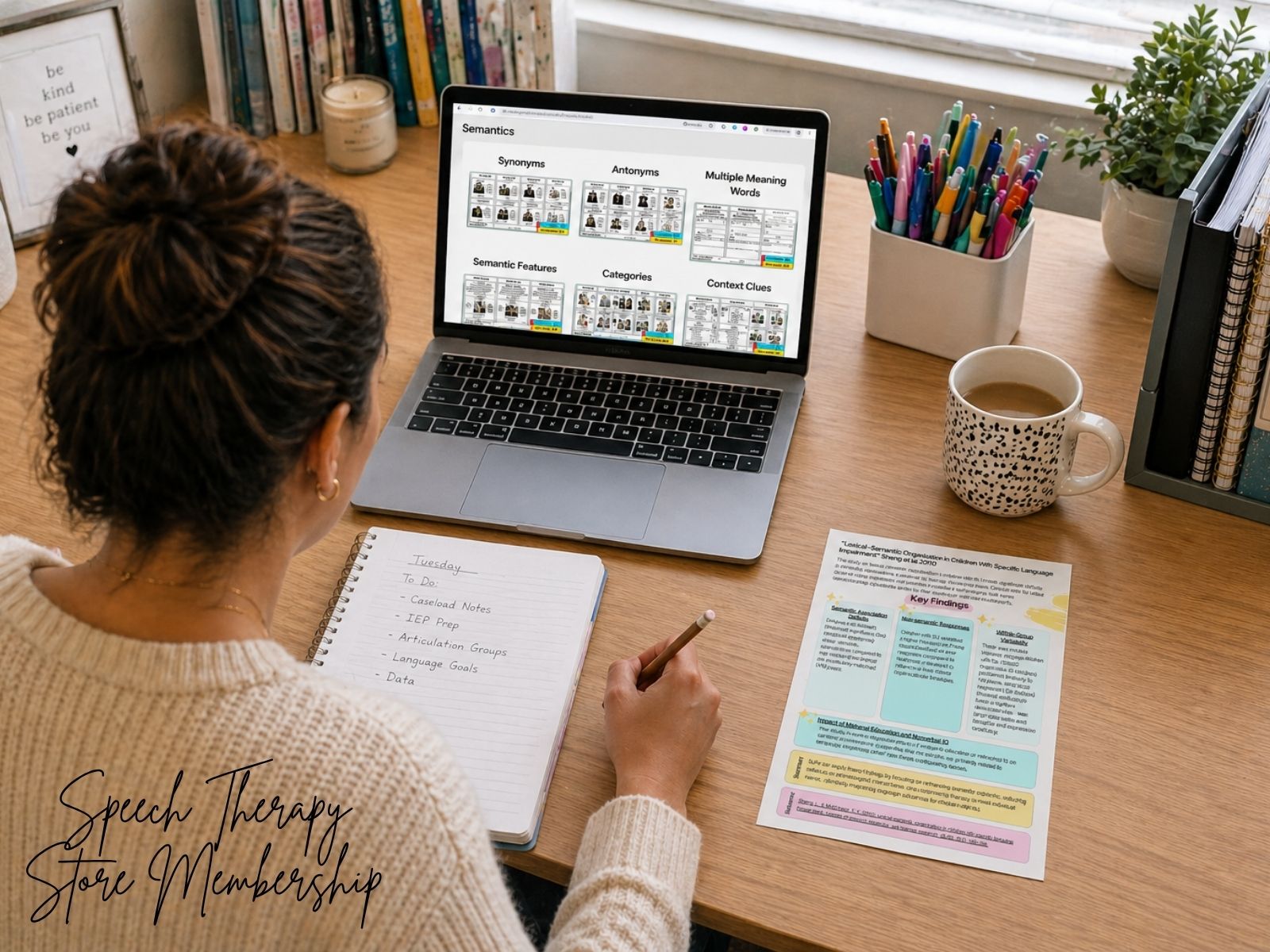
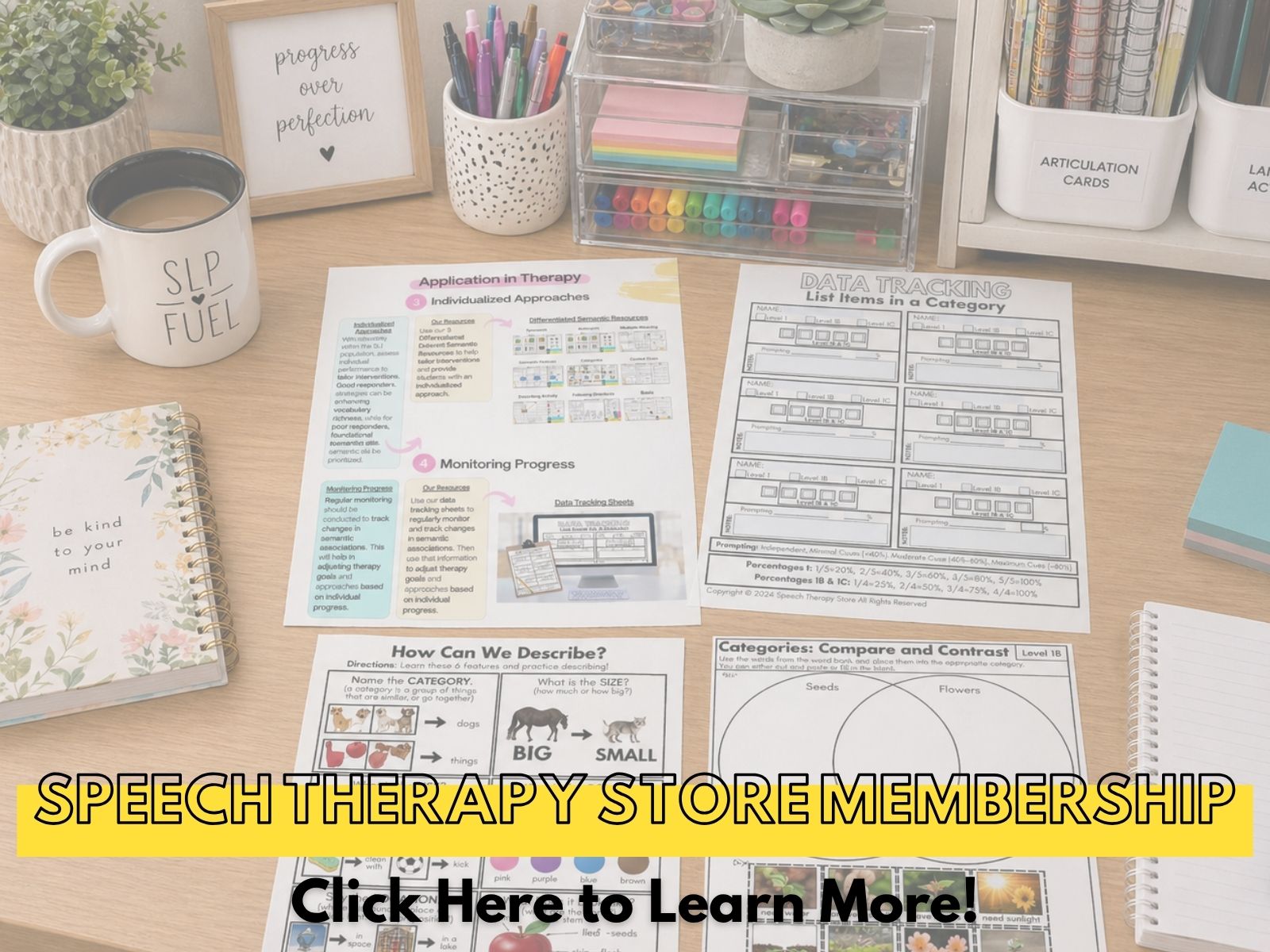
This is the idea behind the Speech Therapy Store Membership.
Each month, students are introduced to a nonfiction article that is rich in Tier 2 vocabulary. From there, they don’t just practice the words—they interact with them in multiple, meaningful ways across activities.
Students work on:
- synonyms and antonyms
- multiple meaning words
- semantic features and describing
- categorization and word relationships
- context clues
- following directions and basic concepts
Because all of these skills are connected to the same vocabulary and theme, students are not just learning new words—they are strengthening how those words are organized and stored in their brain.
This kind of repeated, meaningful exposure is what helps build stronger semantic networks over time—supporting both language development and comprehension.
Reference
Sheng, L., & McGregor, K. K. (2010). Lexical–semantic organization in children with specific language impairment. Journal of Speech, Language, and Hearing Research, 53(1), 146–159.